Hook
A Reason Offered Too Quickly Becomes a Verdict
On October 16, United Nations human rights monitors in Ukraine reported that at least 328 civilians were killed and 2,105 injured in September, 85 percent more than in September of last year (UN News, 2026).1 The count also showed how the harm was spread: in the city of Kyiv, civilians were killed or injured on 22 of the month’s 30 days (UN News, 2026).
The figure that stays with me is the 22. A total can be read as a single catastrophe, but twenty-two days out of thirty reads as a condition. Numbers like these tend to arrive with an unspoken second sentence, and that sentence goes looking for a reason, partly because a cause makes a catastrophe feel manageable: whatever has a reason might, in principle, be handled.
Asking why is not the fault. Investigators trace causes, courts assign responsibility, and both are necessary. The trouble begins when the search for a reason lands on the sufferer, and a gap in someone’s story is mistaken for a stain on it.
Scripture’s oldest sustained argument about innocent suffering turns on exactly that distinction. It opens with a ledger of loss that reads like a dispatch, raiders and a collapsed house, and then sends three visitors to a man stripped of everything he owned. (The previous installment followed a queen who spent her standing on a single sentence: What Does “For Such a Time as This” Mean?)
Historical Case
Lisbon Reopened Job’s Question in 1755
Job begins with the logistics of loss. In one day, Sabean raiders drive off his oxen and donkeys and kill the servants who tend them, Chaldean bands carry off his camels, and a wind from the wilderness brings down the house where his children are feasting (Job 1:13–19). The frame sets human violence beside natural catastrophe and does not sort them, which may be why the book keeps being read in the wake of wars and earthquakes alike.
On November 1, 1755, an earthquake, a tsunami, and fires broke Lisbon. Estimates of the dead vary widely, though most modern accounts reach into the tens of thousands (Kendrick, 1956).2 The argument that followed was not a tidy contest between three positions. In 1756, the Jesuit Gabriel Malagrida published a pamphlet reading the disaster as divine anger at the sins of the Portuguese people and court, and he argued against those who offered natural causes (Malagrida, 1756).3
Voltaire’s Poem on the Lisbon Disaster pressed the question whether infants had earned such an end, as a challenge to easy confidence in providence. Rousseau’s reply moved the argument again, noting among other points that the density of the city’s housing was a human arrangement that raised the toll (Neiman, 2002).4
Voltaire’s quarrel was with philosophical optimism, and Job’s is with a theology of strict retribution. The two overlap on one question, whether suffering counts as evidence of guilt, and differ on nearly everything else. Lisbon did not repeat the book of Job. It put the same question to a new century.
Biblical Lens
“…and none spake a word unto him: for they saw that his grief was very great.” (Job 2:13, KJV)
Presence before interpretation.
“O earth, cover not thou my blood, and let my cry have no place.” (Job 16:18, KJV)
A cry that refuses to be buried.
“…ye have not spoken of me the thing that is right, as my servant Job hath.” (Job 42:7, KJV)
The rebuke falls on the explainers.
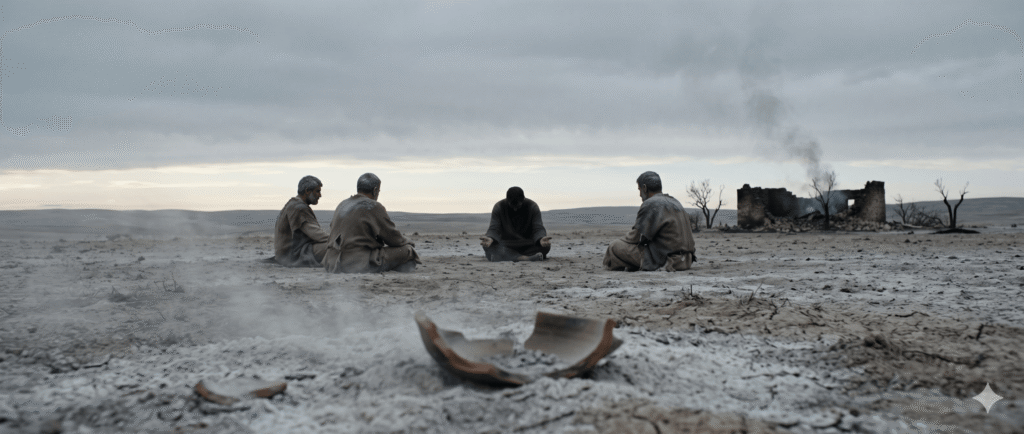
The weight sits on the first verse. The friends begin by sitting, with no theory in hand. Silence is not the virtue here. The virtue is that they take in Job’s grief before they classify it.
Once the speeches begin in chapter 4, the sequence turns: they stop explaining the grief and start revising the man. Eliphaz asks whether the innocent ever perish (4:7). Bildad suggests that Job’s children died for their own transgression (8:4), a sentence spoken to their father. By chapter 22, Eliphaz is itemizing crimes, water withheld from the weary and bread from the hungry (22:6–7), that the narrator never shows Job committing.
To keep a moral world in which suffering tracks guilt, the friends must rewrite Job’s biography until it fits. The narrator has already told us twice that he was blameless (1:1; 2:3), so the reader watches inference harden into accusation. This does not make every sufferer innocent. What the book shows is narrower: suffering alone gives no one license to pass a verdict on the sufferer.
Job’s reply in 16:18 is not a request for an archive. He asks that the injustice not be covered over, and that his cry be allowed to reach someone. The rebuke in 42:7 then lands on the three friends, though the book does not endorse every word Job spoke, since the divine speeches of chapters 38–41 challenge him as well.5
Scripture holds passages of judgment, and it does not ask us to read every ruin as a sentence handed down from above; Job is the book that puts that certainty on trial. What remains standing is narrower: the wreckage of a society, and what it does about the wreckage, discloses the arrangements it had chosen to live under.
Pattern Insight
A Just World Is Comforting, and It Costs the Sufferer Twice
In 1966, the psychologists Melvin Lerner and Carolyn Simmons had 72 female undergraduates watch a peer who appeared to receive painful electric shocks during a learning task. The authors reported that observers tended to devalue a victim they believed would go on suffering, and they read this as evidence of a need to believe in a just world (Lerner & Simmons, 1966; Lerner, 1980).6 That is what the experiment found.
The interpretation is the authors’, and later researchers have debated it. The study comes from a mid-century laboratory and cannot tell us what moved any figure in Job.
Here the data stops and the inference begins, and it is mine. Bildad and Eliphaz may have been frightened, because if Job’s children died undeserving, nothing guarantees that theirs will not. The text does not say so. Fear would explain the friends without excusing them: a fear that rewrites a grieving father’s life as a ledger of crimes still harms him.
Immanuel Kant read the book on a different layer in 1791. He treated the friends as practitioners of “doctrinal” theodicy, the justification of God’s ways by argument, and judged the whole genre a failure. Their fault was not mere doctrine but insincerity: they spoke as though God were secretly listening and approving, while Job spoke as he thought and admitted what he did not know (Kant, 1791).7
Between them, Lerner and Kant describe one movement from two sides, in which anxiety manufactures confidence. Lerner explains why an observer reaches for an answer; Kant names what it costs to claim an answer one does not hold.
The theologian Gustavo Gutiérrez heard a third movement. As he reads the book, Job’s lament begins in private pain and refuses to stay there, widening toward the poor and the unheard, so that innocent suffering becomes a social fact and not only a personal crisis (Gutiérrez, 1987).8
Job 24:12, “men groan from out of the city,” is at most a partial echo of any modern siege, since the passage describes the oppressed of Job’s own world. But the widening matters. When harm has human authors, naming them is not the friends’ mistake. The mistake is turning on the victim.
Most readers will meet this scene at a smaller scale: a hospital corridor, a funeral reception, a friend whose marriage is ending. The pull to explain is strongest there, and it presents itself as help. One earlier essay here told of a teacher whose answer was a year of ordinary mornings beside a six-year-old at a second desk (The Second Desk). Listening has to come before explanation, and the friends held that order for seven days.
Closing
What the Friends Got Right Lasted Seven Days
Return to the twenty-two days. A reason offered too quickly becomes a verdict, and a careful count refuses to do the friends’ work: it records dates and districts and leaves the sufferers’ lives unrewritten. In Gutiérrez’s reading, Job’s lament widens from one man’s sores toward the unheard, and a count kept day by day is a small, dry way of letting a private loss be heard as a public one. The question of who bears responsibility for such harm is a separate and necessary one, and it is put to those who make the decisions, never to the dead.
For seven days, Job’s friends did the one thing the book does not fault. Then the explanations began, and the book’s ruling fell on them. What remains is a man scraping his sores with a potsherd (Job 2:8), and three people who, for a week, decided not to say what it meant.
The oldest book on innocent suffering withholds the explanation the friends were so sure they held, and rules against those who explained too soon.
- UN News, “Ukraine: Civilian casualty rates among ‘deadliest’ in years, as energy attacks intensify,” Oct. 16, 2026, news.un.org/en/story/2026/10/1168614. See also the UN Human Rights Monitoring Mission in Ukraine, monthly update of Oct. 16, 2026, ukraine.ohchr.org.
- T. D. Kendrick, The Lisbon Earthquake (Methuen, 1956).
- Gabriel Malagrida, Juizo da verdadeira causa do terremoto que padeceo a corte de Lisboa (Lisbon, 1756).
- Susan Neiman, Evil in Modern Thought (Princeton University Press, 2002).
- On Job 42:7, translators divide over whether the Hebrew preposition means “of me” or “to me,” and so over whether Job spoke rightly about God or to God. Either reading leaves the rebuke on the friends.
- M. J. Lerner and C. H. Simmons, “Observer’s Reaction to the ‘Innocent Victim’: Compassion or Rejection?” Journal of Personality and Social Psychology 4, no. 2 (1966): 203–210. Melvin Lerner, The Belief in a Just World (Plenum, 1980).
- Immanuel Kant, “On the Miscarriage of All Philosophical Trials in Theodicy” (1791), Akademie ed. 8:253–271, in Religion and Rational Theology, ed. Allen Wood and George di Giovanni (Cambridge University Press, 1996).
- Gustavo Gutiérrez, On Job: God-Talk and the Suffering of the Innocent, trans. Matthew J. O’Connell (Orbis Books, 1987).
New essays every week. Delivered quietly.