Hook
He Began Writing on His Wedding Day
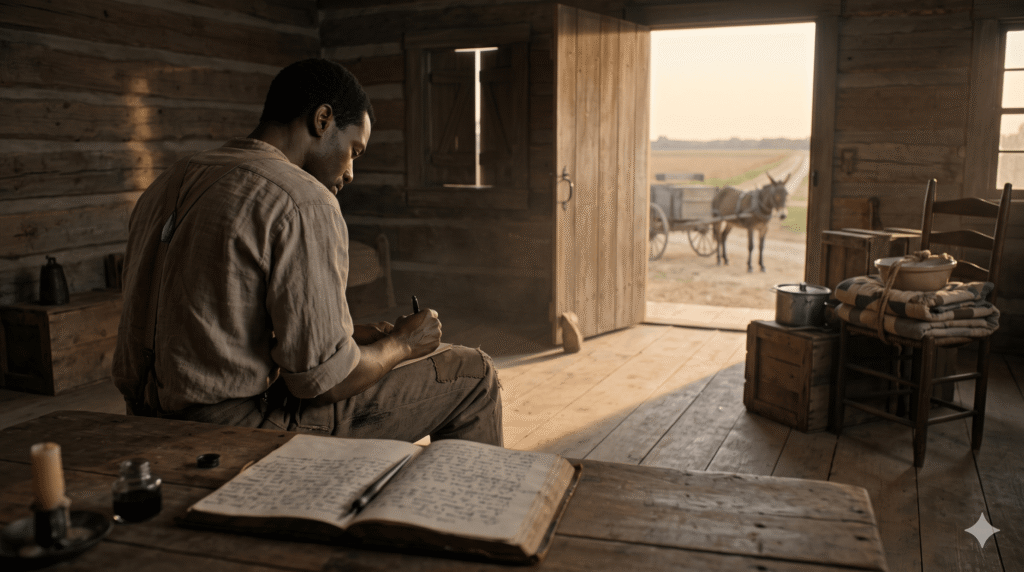
On May 30, 1841, Adam Francis Plummer married Emily Saunders and began a diary the same day. He was enslaved in Prince George’s County, Maryland, and nothing he wrote could secure his family’s freedom. On May 30, 2026, exactly 185 years later, the Smithsonian’s Anacostia Community Museum opened an exhibition called “We Make History” around that diary, and it will stay on view through January 2028 (Alexander, 2026; Mehrtens, 2026).[1] The curator, Jennifer Sieck, has described it as likely the only multigenerational diary begun by an enslaved person in the United States (Alexander, 2026).
I keep returning to a detail that gets a single clause in the coverage I read: the lists. Alongside births and deaths, Plummer set down household goods, debts owed and debts paid (Mehrtens, 2026). It is easy to hurry past those pages toward the ones that break the heart.
One of those lists was an inventory of the cabin where his wife lived, made in 1852 as she and her belongings were about to be moved into another owner’s household. What that list came to mean sits at the center of what follows.
Historical Case
Eight Miles of Saturday Evenings
Plummer was born in 1819 and brought to the Riversdale plantation at the age of ten. There a Black preacher named John Bowser taught him to read and write, a risk that would likely have cost both men dearly had anyone found out (Mehrtens, 2026; Riversdale House Museum, n.d.).[2] Historians of the period describe such lessons as widespread, secretive and dangerous for teacher and student alike.[3] His daughter Nellie would later write that without that single chance, the family would know very little of its own history (Mehrtens, 2026).
In 1839 he met Emily Saunders, an enslaved cook on a neighboring estate. On May 30, 1841, they were married at New York Avenue Presbyterian Church in Washington. For the next ten years he was permitted to travel the eight miles to her cabin on Saturday evening and was due back before work began on Monday, carrying food, mending the walls, building furniture (Riversdale House Museum, n.d.).
In 1845 they planned to flee north, meaning to use their marriage license as free papers, an unusual document for an enslaved couple to hold. A relative of Emily’s betrayed the plan, and she was sent to the fields. In 1849 she and four children were put up for sale, and after the owner’s death in 1851 Emily and three of the children were sold to a household in Washington (Riversdale House Museum, n.d.).
An earlier essay here sat in a courthouse corridor where a decree had ended a marriage in law and left trust unresolved (Mr. Smith and the Burden of Proof). The Plummers had the reverse problem. Their license did not prevent either sale. What held the marriage together afterward was mostly Adam’s feet, his tools and his pen.
Then, in 1852, came the inventory. Before Emily’s belongings went to Washington in a wagon her husband’s owner allowed him to use, Adam wrote down what stood in her cabin. The museum’s booklet notes that the items ran well beyond the bare essentials one might expect (Riversdale House Museum, n.d.).
Three years later, on December 22, 1855, the family was moved again, this time to Howard County, and Plummer lost track of where they had gone. His entry opens, “Brokeup and parted in the end of the your of 1855 December 22” (spelling as in the original; Plummer diary, as reproduced in Mehrtens, 2026). After five months of looking, he received a letter from Emily dated March 2, 1856.
Biblical Lens
Three Passages for a Reader Not Yet Born
Three passages sit near this diary, and each handles a different part of it: who gets remembered, how plainly a message is written, and who receives it. None of them was written about a diary like this one, and the fit is partial.
Then they that feared the LORD spake often one to another: and the LORD hearkened, and heard it, and a book of remembrance was written before him for them that feared the LORD, and that thought upon his name.
Malachi 3:16 (KJV)[4]
The book in Malachi is not kept for the powerful. It records ordinary speech between ordinary people in a season when serving God seemed pointless (Malachi 3:13–15). It is God’s remembrance, though, and Plummer’s diary is a human one. The passage names a hope for the family, and it does not describe what happened to them.
And the LORD answered me, and said, Write the vision, and make it plain upon tables, that he may run that readeth it.
Habakkuk 2:2 (KJV)
The command concerns one prophetic vision, not all writing, but it offers a point of craft: a message meant to travel must be plain enough for a reader in motion. Plummer’s spelling was his own. His daughter, a schoolteacher, corrected it and added details to his accounts (Alexander, 2026), and both hands remain in the one book.
That the generation to come might know them, even the children which should be born; who should arise and declare them to their children.
Psalm 78:6 (KJV)
The psalm describes a chain of telling, each link addressed to people not yet born. Its subject is the works and law of God, which is wider than one family’s ledger, though Nellie’s memoir, titled Out of the Depths; or, The Triumph of the Cross, claims that wider frame for her family’s story (Plummer, 1927).
Nothing I found suggests Plummer had these verses in mind as he wrote. His great-great-grandson, the Reverend L Jerome Fowler, describes him as a man of faith, steadfastness and devotion to family (Riversdale House Museum, n.d.). The verses are the lens I bring to the diary, not one he gave it.
To read Plummer’s ordeal as heaven’s verdict on the man who endured it would be a mistake, and Scripture does not ask for it. What its writers press, patiently and across centuries, is something sterner: what a people counted and kept, whose births it logged and whose sales it signed, ends up testifying to the terms on which it chose to live. Property records counted Plummer among another man’s holdings. His own pages counted his family.
Pattern Insight
Everything Important Arrived by Mail
The numbers are plain enough. Plummer wrote for more than sixty years, from 1841 until his death in 1905 (Mehrtens, 2026). He spent a decade of weekends on an eight-mile road.
His search for his family in 1855 and 1856 lasted five months. When Nellie published her memoir in 1927, she mortgaged a home for $1,000 to pay for it, and some relatives, including her twin brother Robert, worried about airing the painful details (Mehrtens, 2026; Riversdale House Museum, n.d.).
Totals like these invite a story about endurance, and endurance is certainly in them. Running underneath it is a thread worth following: how much of this family’s history traveled as mail.
Emily’s letter found Adam after five months. From Louisiana, where Sarah Miranda had been sold in 1860, she wrote to her family; after the war her brother Henry went to bring her home, and in thanks for her return she founded St. Paul Baptist Church in Bladensburg, Maryland (Riversdale House Museum, n.d.). Nellie carried the family’s letters to the historian Carter G. Woodson, who published the Plummer correspondence in 1926 (Mehrtens, 2026). And when her own book was printed, she mailed copies across the country, sending boxes even to towns she had never visited, with instructions to the postmasters to pass them to every Arnold and Plummer (Mehrtens, 2026).
A letter could not stop a sale. It could only tell a husband where to walk. That limit belongs in the account, and it is part of why the record mattered: what could not be prevented could still be written down.
An earlier essay here on Emily Roebling dealt with labor that waited more than a century for its record (The Telescope in Brooklyn Heights). Plummer ran the sequence backward. He wrote the record while the work was still being done and let the credit wait.
Scripture’s records tend to be written in that direction, toward someone. The prophet is told to write so that a reader may run with the message, which is the language of something meant to travel. The psalm imagines children who will tell their children. A record is a letter whose reader has not yet been born.
The diary itself shows what happens when an address goes dead. For years it was thought lost or destroyed. Nellie had entrusted it to a cousin, and it later passed to a descendant who kept it in her attic; she learned in 2001 that the family was looking for it (Riversdale House Museum, n.d.; Mehrtens, 2026).
In Sieck’s telling, the diary reached the museum by way of Nellie’s book, which had kept relatives able to find one another (Alexander, 2026). The memoir was, in that sense, the diary’s forwarding address.
In June 2025, roughly forty members of the family came to see it in person. Sieck said the young people among them asked questions about what she called a family treasure, and also a community and national one (Alexander, 2026).
Closing
What the Lists Were For
I do not know why Plummer counted the contents of Emily’s cabin before the wagon left. A practical man might have wanted a record of what was taken from a home he had kept up with his own hands. A husband might have wanted to know what his wife would have when she arrived.
Both reasons can be true at once, and neither is written down. Only the list is.
In the previous installment, Oseola McCarty’s last six dimes crossed a banker’s table in someone else’s hand (Ten Dimes). Plummer’s record crossed generations the same way, through hands he would never meet: a daughter who corrected and continued it, a cousin who held it, a woman with an attic, a curator with a gallery and a date.
That brings the lists back.
The lists did not recover a single right the law had taken. They became something smaller and more durable: a precise account of what once stood in a cabin, written by the man who had mended its walls, and left for readers he would never meet.
- Jimmy Alexander, “A 185-year-old diary is the center of the Anacostia Community Museum’s new exhibit,” WTOP News, May 29, 2026; Michelle Mehrtens, “This 19th-Century Diary Written by an Enslaved Maryland Man Is a Crucial Record of His Life and Family History,” Smithsonian Magazine, July 17, 2026.
- Riversdale House Museum (Prince George’s County, Maryland), interpretive booklet on Adam Francis Plummer, riversdale.org, undated. The booklet spells the preacher’s name “Bowzer”; Smithsonian Magazine spells it “Bowser.”
- For the wider history of enslaved literacy, see Heather Andrea Williams, Self-Taught: African American Education in Slavery and Freedom (Chapel Hill: University of North Carolina Press, 2005). It is cited here for background on the period, not as a source for Plummer’s own account.
- Scripture quotations are from the King James Version (public domain). Nellie Arnold Plummer, Out of the Depths; or, The Triumph of the Cross (Hyattsville, MD, 1927; repr. New York: G.K. Hall, 1997), introduction by Joanne M. Braxton.
New essays every week. Delivered quietly.