S1 · Hook
The Most Feared Man in Europe Built His Own Funeral Fire
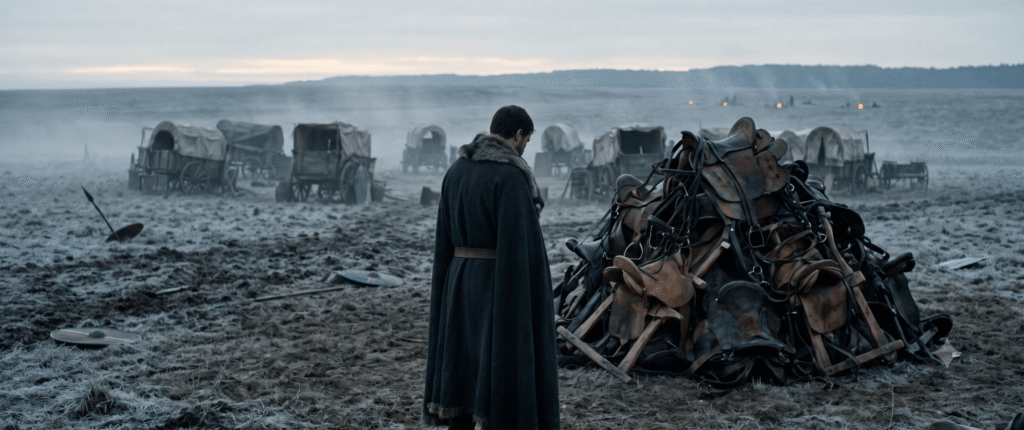
For longer than I care to admit, I have been staring at a single sentence in the Getica, a history of the Goths written in the sixth century, roughly a hundred years after the events it describes. Jordanes reports that on the night after the great battle of 451, Attila had his men pile horse saddles into a heap. If the enemy broke into his ring of wagons, he would throw himself on top and let it burn.
By Jordanes’s account, the pyre was a precaution that was never needed. No one stormed the wagons, and the saddles were never lit. By morning, the man who had crossed the Rhine with half a continent’s dread behind him was alive, cornered, and still able to leave.
The battle was fought on a plain in Gaul whose exact site scholars still dispute. In the previous installment, we examined the conversion of Constantine and the empire that took a cross for its banner. A hundred and thirty-nine years after the battle at that bridge, the Roman West held against Attila with the help of men the empire had fought within living memory. Whether that counts as rescue is the question this essay stays with.
S2 · Historical Case
An Empire Defended by the Men Who Once Sacked It
Flavius Aetius, who organized the defense of Gaul, had spent part of his youth as a hostage among the Huns. Years later he brought Hunnic horsemen into Roman politics to back his own cause. In 451 those horsemen stood on the other side, and what Aetius had was a thin field army and a talent for assembling people who distrusted one another.
The largest piece of that assembly was the Visigoths under King Theodoric I, and their record with Rome ran in both directions. Alaric’s Goths sacked the city in 410. After 418 the empire settled the Visigoths in Aquitaine under a treaty, and for the next decades treaty and war traded places. In 439 a Roman force under Litorius was routed outside Toulouse (Prosper, c. 455). Religion added another seam, since the Goths followed the Arian form of Christianity that Rome’s bishops counted as heresy. Theodoric owed Rome no affection, only an agreement that each side renewed or strained as its interests moved.
Attila, by Jordanes’s account, wrote to both courts, trying to pry them apart, and told the emperor that his quarrel was with the Goths alone. That gave Theodoric a stake of his own. Tradition credits the aristocrat Avitus with persuading the king to join Rome, and Alans, Franks, Burgundians and others took their places in the line. Aetius, according to Jordanes, set the Alans, whose loyalty he doubted, in the center.
By the traditional reckoning, the armies met in late June. The fighting ground on until dark around a ridge both sides wanted. Theodoric fell, Jordanes reports, thrown from his horse and trampled, though he also passes along a second version in which an Ostrogoth named Andag killed the king with a spear (Jordanes, c. 551). His son Thorismund, lost in the night, stumbled into the Hun wagons and was wounded before his men found him.
The irony was built into the field, since Goths also marched in Attila’s army, and Gothic kin faced Gothic kin. Jordanes adds a detail I cannot read without slowing down. When the Visigoths found their king among the dead, they sang over him within earshot of the enemy and carried him away.
The next day Thorismund wanted to besiege the wagon camp and finish the Huns. Jordanes gives Aetius a motive here, a fear that if the Huns were destroyed the Goths would turn on Rome. He has Aetius advise the prince to hurry home and secure his throne before his brothers could claim it. Thorismund agreed, and Attila slipped away.
S3 · Biblical Lens
Two Short Books, Two Different Debts
Ruth and Obadiah together run barely a dozen pages, and they ask almost opposite questions. One follows a woman who takes on a debt no one could demand of her. The other indicts a people who refused a debt everyone knew they owed.
Ruth tells Naomi she will not turn back. Wherever Naomi goes, she will go; Naomi’s people will be her people, and Naomi’s God her God. (Ruth 1:16, my paraphrase)
Obadiah tells Edom that on the day strangers carried off his brother’s wealth, he stood nearby and became one of them. (Obadiah 1:11, my paraphrase)
The prophet adds that Edom should not have gloated over his brother’s day of ruin, nor looted his gate in the day of his calamity. (Obadiah 1:12–13, my paraphrase)
Neither book asks us to read every ruin as a verdict. Both insist, though, that what people do on the day another’s walls fall shows the moral conditions they had already chosen to live in.
Ruth stands at one pole. Boaz later praises her conduct with the Hebrew word hesed, a faithfulness that goes beyond what any agreement demands (Ruth 3:10). She was a Moabite, from a people Israel’s law treated warily (Deuteronomy 23:3), a wariness that hardened again in the age of Ezra and Nehemiah, as I explored in an earlier essay on mixed marriages. She crossed that line out of love for one woman, with no treaty and no advantage in view.
Edom stands at the other. He is kin, a brother nation, and the charge against him is betrayal of blood. Between those poles lies the plain of 451, where Goths and Romans were neither lovers nor brothers. They were parties to an agreement, and Theodoric had his own throne at stake.
So I will not call Theodoric Ruth, or Aetius Edom. The books do not hand us a mapping, only two questions that survive the poor fit.
S4 · Pattern Insight
The Arithmetic Nobody Trusts, and the Question Nobody Can Close
The sources give the battle in numbers, and the numbers are enormous. Jordanes puts the dead at about 165,000, apart from an earlier clash on the eve of battle, and other chroniclers give totals larger still. Modern historians treat such figures as rhetoric. Late Roman armies were far smaller than the arithmetic implies, and the cost of the day is better measured in what followed (Heather, 2005).
What followed is worth setting in a row. Theodoric died on the field in 451. The next year Attila turned on Italy, and he withdrew without taking Rome. By tradition, he died in 453 of a nosebleed on his wedding night. Thorismund, who took the Gothic throne, was killed by his own brothers that same year. In 454 the emperor Valentinian III killed Aetius, by most accounts with his own hand, and Valentinian was himself murdered in 455. Apart from Theodoric, none of them fell in battle.
I do not read that sequence as judgment, and the disclaimer above already says why. I read it as evidence that a military result and a political settlement are different things. The battle halted Attila’s campaign in Gaul. It did not end the threat, since he was in Italy within a year, and it did not make the coalition trust itself afterward. The line held for a season without ever becoming a peace.
A winning alliance is not therefore a righteous one, and a righteous choice does not therefore win.
That is where the two books earn their place. Ruth asks what binds us to people who owe us nothing. Obadiah asks what standing aside costs when a neighbor falls. Theodoric’s case sits uncomfortably between them, because his motives braided together obligation and self-interest, and no source can pull the strands apart.
Alliances forged against a shared threat are tested hardest on the morning after the threat recedes, and this one was no exception. Trust that has been broken is rebuilt slowly and by particular acts, a point I made when writing about rebuilding trust in marriage. An alliance has far fewer of the ties that make that work possible.
As for Aetius letting the Huns go, the sources cannot settle why. Historians often read the restraint as a balance-of-power calculation, though the sources give us only the motive Jordanes chose to assign, a fear that a Gothic kingdom which had crushed the Huns would grow too strong to manage. I am not sure we should want that question closed.
S5 · Closing
A Line Is Not the Same as a Peace
The saddles were never lit, and I have come to think of them as the truest monument to that battle. They mark a fire that was prepared and not needed, a victory that was real and not complete. The Roman West lasted another twenty-five years, and no surviving source can say how much of that was Theodoric’s doing.
What the sources do preserve is the song. The Visigoths who chanted over their king in the dark did not know how the story would end. They knew only that the man was dead and that they would not leave him to the enemy. That small, stubborn act of loyalty needed no treaty to explain it, and I find it harder to forget than any count of the fallen.
A coalition can win a day and leave the harder work undone. What remains afterward is what the allies owe one another once the common threat has gone home.
- Jordanes, Getica (c. 551), trans. Charles C. Mierow. Source for the saddle pyre, Theodoric’s death, Thorismund’s night wandering, Aetius’s advice, and the casualty figure. Written about a century after the events, from lost earlier sources.
- Prosper of Aquitaine, Chronicle (c. 455). Source for the 439 defeat of Litorius.
- Peter Heather, The Fall of the Roman Empire (2005).
- Christopher Kelly, Attila the Hun: Barbarian Terror and the Fall of the Roman Empire (2008).
New essays every week. Delivered quietly.