A notice, a deadline, and what two arms can carry
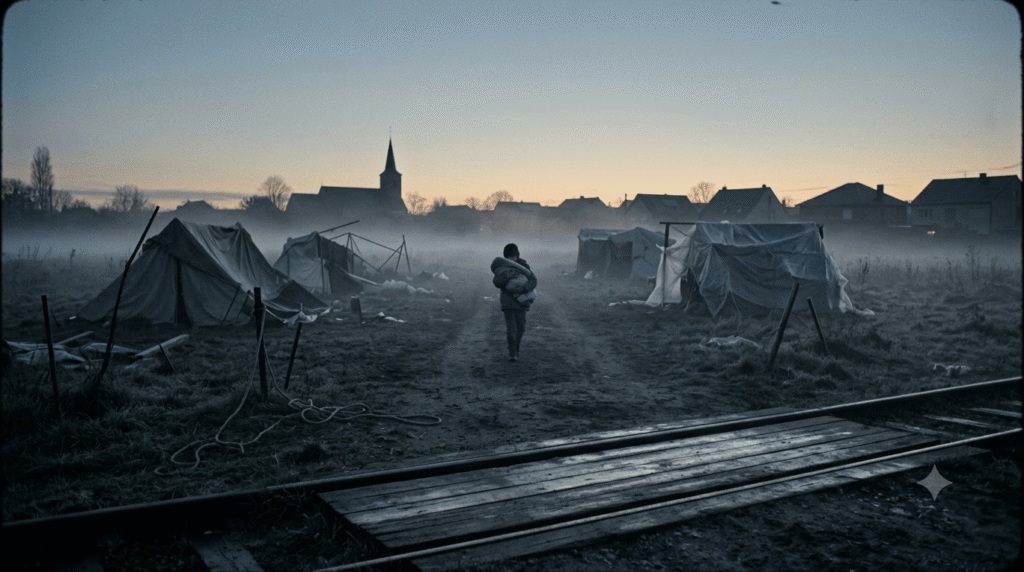
Before sunrise on Tuesday, September 15, 2026, city crews began clearing the long-established homeless encampment along Berkeley’s Harrison corridor, at Eighth Street.1 The city had warned of the coming sweep for weeks; its vacate notices, posted September 11, gave residents until the fifteenth to leave.1 A federal judge had allowed the operation to proceed, subject to protections for certain residents with disabilities. Every step moved through the proper channels: a notice, a deadline, a ruling.
I keep returning to one detail that never makes it into the headlines. It is the arithmetic of a departure: how much of a life fits into two arms in the time it takes to be told to leave.
City officials keep an arithmetic of their own, one that counts fires, sanitation, and the safety of the people inside the camps and beside them. Since June 28, 2024, in City of Grants Pass v. Johnson, the Supreme Court has held, 6–3, that enforcing public-camping bans does not violate the Eighth Amendment’s ban on cruel and unusual punishment.2 Both sets of figures are real. Neither is the arithmetic this essay is about. This one is about three dollars.
In April 1931, a Paramount comedy hung its entire plot on three dollars, a dog license, and a shantytown that a respectable doctor wished to see torn down.
A comic-strip boy at a divided ceremony
Skippy began as a newspaper comic strip by Percy Crosby, and Paramount released the film on April 5, 1931, roughly a year and a half after the market crash.3 By then the word shantytown carried a hard second meaning for its first audiences, who were watching Hoovervilles rise on the vacant edges of their own cities. In that year a few dollars could stand between a household and going without, which is part of what gives the film’s small sum its weight.
Its hero, Skippy Skinner, is the son of a physician in a small Indiana town, and he has been forbidden to set foot in Shantytown, the ramshackle settlement across the tracks. He goes anyway. There he defends a smaller boy named Sooky Wayne from a bully, and the two become inseparable.
Then the machinery of the town closes around a dog. The dogcatcher, Mr. Nubbins, impounds Sooky’s pet, demands payment for a broken windshield, and gives the boys three days to find three dollars for a license.3 They break open Skippy’s savings bank. They sell bottles, lemonade, and firewood, and they stage a show. The money does not arrive in time, and the dog is killed.
Skippy blames his own father. The next morning he trades away the new bicycle he has just been given for a neighbor girl’s puppy and carries it to Sooky. Only then does the town health official who wanted Shantytown cleared change his mind and let it stand.
The Academy took notice. At the 4th Academy Awards, held in November 1931, the film was nominated for the top prize, then called Outstanding Production, and nine-year-old Jackie Cooper became the youngest nominee ever for Best Actor. Norman Taurog won Best Director at thirty-two, and no one younger won that award until 2017.4 The top prize that night went to Cimarron. In the previous installment, we examined that picture and its land run through Genesis 13. The pairing is hard to miss. The year’s top prize went to a film about who gets to stake a claim on open ground, while the directing Oscar went to a film about who gets to stay on ground already claimed.
The lamb, the child, and the meeting place
Scripture keeps an old story about a small animal and a large injustice. In 2 Samuel 12, the prophet Nathan brings King David a case involving two men in one town. One owns vast flocks and herds. The other owns a single lamb, which he raised beside his own children and fed from his own table. When a guest arrives, the wealthy man spares his own animals and takes the poor man’s lamb for the meal.
“But the poor man had nothing, save one little ewe lamb.” (2 Samuel 12:3, KJV)
The Gospels turn the image around. When the disciples argue over which of them is greatest, Jesus calls a child over and sets him “in the midst of them” (Matthew 18:1–3, KJV), where the grown men who had been ranking themselves have to look at him. And the Proverbs compress the whole social map into one line:
“The rich and poor meet together: the LORD is the maker of them all.” (Proverbs 22:2, KJV)
Why a story about a dog can do what an ordinance cannot
Numbers first, because the film is precise about them. Three dollars was the price attached to the dog’s license. Three days was the deadline. Two boys did the raising, and one bicycle finally closed the gap. Set beside the tallies from Berkeley — two city blocks, a notice, a deadline — these figures share a single feature: not one of them is large. Systems rarely reveal themselves through large numbers; they reveal themselves in the smallest thing they are willing to price.
But the figure that matters is not in the ledger. Scripture is wary of ledgers to begin with; the same books that count lambs also record what happened when David insisted on numbering his people and found that a nation counted is not the same as a nation seen. It is what a small case can do to a large mind.
Nathan never tells David, “You have wronged Uriah.” He tells him a story about a lamb. David, who has judged every case in the kingdom except his own, condemns the rich man before he understands that the verdict is about himself. The prophet’s answer takes four words: “Thou art the man” (2 Samuel 12:7, KJV). Uriel Simon named the device a juridical parable, a fictional case laid before the very person who will pass sentence on it, so that he pronounces judgment while still believing himself outside the story.5
Skippy uses a similar moral mechanism in a smaller key. Dr. Skinner does not yield to any argument about Shantytown, and the film gives him plenty to ignore. He yields when the dog dies and his own son, in grief, holds him responsible. A policy about a settlement had no face; a dead dog and a boy’s accusation did.
There is an uncomfortable second layer, and it belongs to the record rather than to me. In his 1981 memoir, Please Don’t Shoot My Dog, Jackie Cooper recalled that when he could not cry on cue for the dog’s scene, his uncle had a studio guard stage a gunshot out of sight, as if the boy’s own dog had been killed.6 Norman Taurog was married to Cooper’s maternal aunt.3 The dog, by that later account, was unharmed. The boy was reportedly inconsolable for hours.7 When the memoir’s editor sought Taurog’s version, he declined to give one.
I don’t offer this as a final judgment on a man who can no longer answer for himself. I offer it because it shows the pattern’s second edge. A child’s trust is the instrument by which a hard adult is made to see, and it is also an instrument that adults have always been tempted to play.
Scripture is less generous with endings than Paramount was. Nathan’s parable brings a king to his knees, yet it does not undo what had already been done. The film gives its audience a father who softens by the last reel.
What a society will take for three dollars
The parable and the film make the same wager. A community’s character is legible in what it will take from the person who has least, and in what it does when someone small looks straight at it. Skippy bet that a father could be moved. Nathan bet the same on a king. Neither bet comes with a guarantee.
A photograph from that first Tuesday morning in Berkeley shows a man standing beside his tent with his dog.8 I draw no verdict from it. The city had real hazards to weigh, and the courts had their own questions to answer. I return to it only because it holds the detail from the top of this page: how much of a life fits into two arms when you are told to leave, and who is standing near enough to see it.
1. Tara Campbell, “Berkeley clears homeless encampment as residents face uncertainty over where to go,” ABC7 (KGO), September 15, 2026.
2. Congressional Research Service, The Eighth Amendment and Homelessness: Supreme Court Upholds Camping Ordinances in City of Grants Pass v. Johnson (LSB11203), July 2024.
3. AFI Catalog of Feature Films, Skippy (1931).
4. Academy of Motion Picture Arts and Sciences, 4th Academy Awards (1931); on Taurog as the youngest Best Director winner until Damien Chazelle (2016), Academy records corroborated by the Skippy production summary.
5. Uriel Simon, “The Poor Man’s Ewe-Lamb: An Example of a Juridical Parable,” Biblica 48 (1967): 207–42.
6. Jackie Cooper with Dick Kleiner, Please Don’t Shoot My Dog (William Morrow, 1981).
7. Aljean Harmetz, “Cooper: A Star at 8, But Happier at 58,” The New York Times, April 16, 1981.
8. Alex N. Gecan, “Berkeley sweeps much of Eighth and Harrison homeless encampment,” Berkeleyside, September 16, 2026.
New essays every week. Delivered quietly.