A Starting Gun Quietly Decides Who Is Allowed to Run
On Saturday, September 19, the town of Perry, Oklahoma, held its annual Cherokee Strip Celebration, a festival held every September since 1893. The day’s program included a 5K and a 10K commemorating the land run of that year. Runners lined up at a starting line, by choice, to mark a day when thousands lined up at another one for land. It is a small thing, but it sent me back to a film.
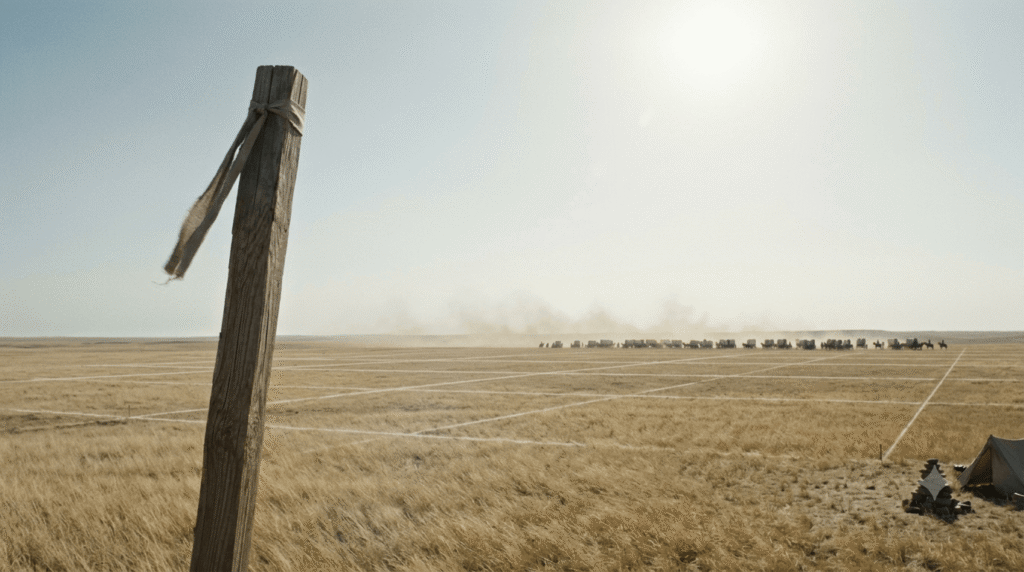
There is a particular kind of silence just before a starting gun. In the first of the Oklahoma runs, on April 22, 1889, an estimated fifty thousand people held it along the edges of the central territory, which Washington had agreed to open at noon, “and not before,” in the words of Benjamin Harrison’s proclamation. Wagon wheels ticked in the dust, and every person on that line was certain the next hour belonged to them.
In 1931, RKO Radio Pictures rebuilt that silence on a ranch outside Los Angeles, with a small army of extras and the largest budget the studio had yet spent. Cimarron won Best Picture that November. It also failed to earn back what it cost.
Modern viewers tend to remember the film for its faults, and they are real. But I keep returning to its opening lines, which tell the audience, in one breath, that the ground was “Indian Oklahoma Lands” and, in the next, that it was “free for the taking.” Both statements sat comfortably on screen in 1931. The country had a word that let them share a sentence.
The word was unassigned.
How One Adjective Turned Land Into Inventory
Unassigned to whom? The answer depends on where you start counting. The land came into federal hands in 1866, in treaties Washington demanded of the Creek and Seminole after the Civil War, when the alliances their governments had made with the Confederacy gave the United States leverage to rewrite nearly every term. Some of the ceded ground went to other tribes; the central piece never did, and the condition attached to it, that it be used to resettle other tribes and freedpeople, hung over the title for two decades. Only in 1889 did Congress pay the Creek and Seminole roughly two million dollars each to clear it.
The word had a partner. By the early 1870s, federal surveyors had already ruled that country into one-mile squares, so that a number could be attached to every piece of it. Then, in 1879, the Cherokee writer Elias C. Boudinot published a newspaper article arguing that the central lands could, and should, be settled by white Americans, and the phrase unassigned lands caught on, as the Oklahoma Historical Society tells it. It was an advocate’s word from the start, a description built to do the work of an argument. The grid sorted the land by the mile; the word sorted it by whose claim was allowed to count.
Then an amendment to the Indian Appropriations Bill authorized Harrison to open the land, and on March 23, 1889, he proclaimed it available to “actual settlers under the homestead laws” (Harrison, 1889). Under those laws a settler could claim 160 acres and earn title after five years of living on the land and improving it, as the Encyclopedia of Oklahoma History and Culture records.
The race itself was less clean than the noon signal suggested. Some people crossed early: railroad workers, soldiers, federal officials, and even deputy marshals, whose job was to enforce the very rules the line depended on. History kept the name for them, sooners, and I have written before about what honesty looks like when no one is watching.
Cimarron compresses all of this into its opening sequence, then follows one family across forty years, from 1889 to 1929. Yancey Cravat, a lawyer and newspaperman played by Richard Dix, is outmaneuvered at the line by a young woman named Dixie Lee, who takes the parcel he had chosen for himself. Landless, he settles in the boomtown of Osage and founds a newspaper. When another run opens in the Cherokee Strip, the one Perry now celebrates, he leaves, and returns five years later. Sabra (Irene Dunne) keeps the paper going, raises the children, and eventually sits in Congress. Yancey dies after pulling oil drillers from an explosion, in her arms.
Edna Ferber’s 1930 novel, the source of the film, was the best-selling book of its year. Ferber wrote in her 1939 memoir that critics and readers alike took it for a colorful romantic Western, which was not quite what she had intended.
Two Men Look at One Horizon
Genesis 13 stages the opposite scene. Abram and his nephew Lot have grown so rich in livestock that the land can no longer carry them both, and their herdsmen have begun to quarrel. Abram is the elder, the one who carries the promise, and he could have pressed his claim. He offers first choice instead.
“Is not the whole land before thee? separate thyself, I pray thee, from me: if thou wilt take the left hand, then I will go to the right; or if thou depart to the right hand, then I will go to the left.” (Genesis 13:9, KJV)
What Lot does next is easy to read past, because it looks so reasonable.
“And Lot lifted up his eyes, and beheld all the plain of Jordan, that it was well watered every where, before the LORD destroyed Sodom and Gomorrah, even as the garden of the LORD, like the land of Egypt, as thou comest unto Zoar. Then Lot chose him all the plain of Jordan.” (Genesis 13:10–11, KJV)
The verse packs two comparisons into one breath. One is Eden. The other is Egypt, the settled, river-fed kingdom Abram had only just come up out of (Genesis 13:1). The plain, in other words, is a garden and a granary at once, and a few lines later the narrator adds that the men of Sodom were wicked (13:13). Nothing about the view is false. Leviticus supplies the frame the whole story assumes.
“The land shall not be sold for ever: for the land is mine; for ye are strangers and sojourners with me.” (Leviticus 25:23, KJV)
That line was spoken to a people about to hold land, and it makes every human claim provisional. The soil is a loan, and the borrowers are guests. Loans leave debts, and the oldest ones tend to become debts no one remembers.
The Same Verb, Two Different Economies
Start with the arithmetic. The Unassigned Lands covered a little under 1.9 million acres; cut into 160-acre homesteads, that is at most about twelve thousand claims, and townsites took some of it. Against that stood an estimated fifty thousand people at the line. Even allowing for families traveling together, the arithmetic left little doubt that many runners would go home without a claim.
Cimarron‘s answer to this arithmetic is to turn the loser into a hero. Yancey never settles. He chases the next opening, and the film seems to love him for it, treating his restlessness as the spirit of the West. Sabra, who stays, gets the newspaper, the town, and the unglamorous work of keeping it alive. The imbalance is visible even where the film does not seem to notice it.
Its blind spots may be the same as the word’s. As the film presents it, Yancey argues for the tribes in his editorials, yet Sabra’s Osage daughter-in-law appears on screen once, in ceremonial dress at a luncheon, and the household servant Isaiah is drawn as a caricature even as the film grants him a heroic death, as reviewers of the restoration have noted. The people whose place in the story was most at stake receive the least of it. To call land unassigned, and to call a story finished, both require someone to stop counting.
Numbers, though, count only who lost. They cannot say what a race teaches the ones who win, and there Genesis is more patient than any statistic. What surprised me on rereading chapter 13 was how much of it is about eyesight.
Lot lifts up his eyes and sees a plain like a garden. A few verses later, after Lot has gone, God tells Abram to lift up his eyes and look in every direction, and promises him all that he sees. The Hebrew uses the same idiom for both, and the stories give it opposite outcomes. Lot’s looking ends in choosing; Abram’s looking ends in a promise.
There is also the matter of how each man settles. Lot pitches his tent toward Sodom, and a chapter later he lives there (Genesis 13:12; 14:12). Abram moves his tent to the oaks of Mamre and builds an altar (13:18). One man’s looking ends in a city; the other’s ends in a tent and a place of worship. Appetite rarely announces its destination. It drifts toward it, one reasonable tent peg at a time.
The runs, too, were one episode in a longer sequence. The historian Angie Debo documented how, in the decades after, the Five Tribes, the Creek and Seminole among them, lost much of the land they had kept, through allotment, legal maneuver, and fraud (Debo, 1940). It was a book her own state’s university press declined to publish, and Debo was barred from teaching in Oklahoma for years afterward. The gun at noon was only the loudest hour of the taking.
Land Held as a Loan Is Tended, Not Defended
A parcel won in a race has to be defended, because everyone who lost the race is still standing at the fence. Land understood as a loan asks something different of its keeper: to tend it, and to remember whose it was before. The first posture builds walls; the second builds a town that outlasts its founder.
I began with the silence before a starting gun. The runners in Perry cross a finish line and go home. The people of 1889 could not, because the finish line was the rest of their lives on the ground they had run to, close enough to notice that it was never really blank. That is the moment unassigned stops working as a word.
In the previous installment, we followed a war that keeps almost ending, and Ecclesiastes’ claim that nothing under the sun is new. A land run is a smaller, quieter proof of the same claim: a new generation, a new starting line, the old hunger for a border drawn across somebody else’s ground. Cimarron half sees this, since its own opening words say whose land it was, which may be why it still rewards watching, the way one reads a witness who reports the facts without grasping what they add up to.
Sources: Oklahoma Historical Society, Encyclopedia of Oklahoma History and Culture, entries “Land Run of 1889,” “Unassigned Lands,” “Indian Meridian (and Indian Base Line),” and “Debo, Angie Elbertha” · Benjamin Harrison, Proclamation of March 23, 1889 · Angie Debo, And Still the Waters Run (Princeton University Press, 1940) · Edna Ferber, A Peculiar Treasure (1939).
New essays every week. Delivered quietly.