The way out was real, and the price of taking it was one he would not pay.
Most accounts of Cannae open with geometry: the bulging center, the wings folding inward, the pincers closing on some eighty thousand men. The account I keep returning to opens with a horse.
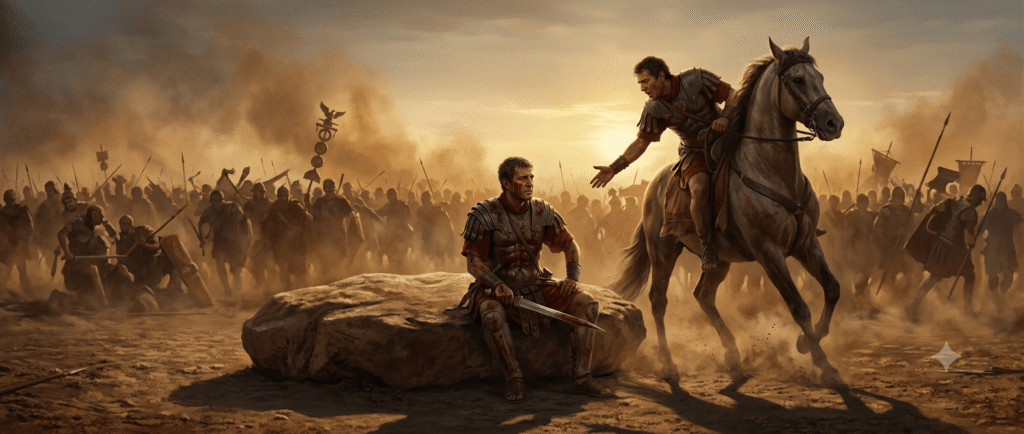
On August 2, 216 BC, a Roman consul sat on a boulder in the Apulian dust, wounded and too weak to stand. A cavalry tribune, Gnaeus Cornelius Lentulus, rode past, reined in, and offered him his mount (Livy, first century BC). It was a sound offer, the kind that men in retreat make once and do not repeat.
The consul said no. He gave his reasons calmly, which is the strangest part, and they were not the reasons a legend would have handed him. On another battlefield, centuries earlier, a king had asked his armor-bearer for one last mercy and been refused. The two refusals were not the same kind of act, and the difference is what this essay follows.
The day belonged to the other consul.
Livy’s account makes Lucius Aemilius Paullus the reluctant consul. Elected in the spring of 216 alongside Gaius Terentius Varro, he inherited an army of roughly eighty-six thousand men (Polybius, second century BC) and a Rome still stunned by Lake Trasimene, where Hannibal had erased a consular army the year before. In Livy’s telling, Paullus is the consul of patience and Varro the consul carried forward on the public’s impatience with it.
The consuls alternated command day by day, and August 2 belonged to Varro. Hannibal, badly outnumbered, let the Roman center push forward into a bulge and closed his wings around it. Paullus, commanding the cavalry on the right, was struck early by a sling-stone and fought on anyway, rallying men at one point after another until his strength gave out and his riders dismounted around him — Livy records a remark attributed to Hannibal on hearing of that order: he would rather have had them handed over in chains.
Then comes the boulder. Paullus thanked Lentulus for his courage and told him not to spend his few remaining minutes on pity. The refusal was not a withdrawal; he sent word ahead. The Senate must fortify Rome before the victor arrived, and Quintus Fabius, whose strategy of delay Rome had abandoned, should hear privately that Paullus had lived and died remembering his counsel.
Then he explained himself. He would die among his slaughtered soldiers, he said, so that he would not be brought to trial a second time after holding the consulship, and would not become the accuser of his colleague, defending his own innocence by laying the guilt on another (Livy). He had already stood trial once, after his first consulship. One can hear a scruple in this, and one can hear an exit: a man declining a hearing he had no wish to endure twice. Livy does not choose between them. What Paullus refused, on this reading, was not only a horse. It was a survival bought with another man’s blame — the version of that afternoon history was already prepared to hand him, if he had wanted it. While the two men spoke, a crowd of fugitives reached them, the pursuers close behind, and Paullus was killed by men who did not know his name. Lentulus escaped on the horse.
Twenty-five years earlier, Rome had ended the First Punic War with a fleet its treasury could not pay for. In the previous installment, we followed Catulus and the citizen-funded ships to the Aegates Islands, where private citizens gave what the state could not. Cannae was the darker side of that ledger: the same Republic asking its citizens to pay, this time with their lives.
The men who went back for the dead.
First Samuel closes with a defeat that has none of Cannae’s arithmetic. The Philistines pressed Israel on Mount Gilboa, and the narrator is blunt about what happened first.
“The men of Israel fled from before the Philistines.” (1 Samuel 31:1, KJV)
By this point Saul is a compromised man; the text has been recording his unraveling for chapters. Wounded by archers, he asked his armor-bearer to end his life before the Philistines could reach him. The young man could not do it.
“But his armourbearer would not; for he was sore afraid.” (1 Samuel 31:4, KJV)
The text offers no principle here, only fear. Saul died by his own sword, and the armor-bearer followed. The Philistines fastened the king’s body to the wall of Beth-shan. The text could have ended there.
It does not. Across the Jordan, the people of Jabesh-gilead heard what had been done. Saul’s first act as king had been to lift the siege of their town, when an Ammonite king offered terms no town should have to accept (1 Samuel 11).
“All the valiant men arose, and went all night.” (1 Samuel 31:12, KJV)
They took the bodies down, carried them home, buried the bones under a tree, and fasted seven days.
Nothing here obliges us to read Gilboa as a verdict handed down from heaven; the text is content to record the collapse. What it keeps insisting, page after page, is that a people’s worst hour exposes the terms on which it has chosen to live.
What a people does with blame.
The numbers are why Cannae became a proverb. Polybius counts some seventy thousand Roman and allied dead, while Livy’s figures run to the mid-to-high forties of thousands, and Livy adds that dozens of senators and former magistrates fell with them. Polybius puts Hannibal’s own losses under six thousand (Polybius; Livy).
Those figures explain the wound. They do not explain why Rome did not die of it. Livy is blunt that Varro bore the chief responsibility for the defeat. Yet when he came home, a crowd of every rank went out to meet him and thanked him because he had not despaired of the state, and Livy sets this against what a Carthaginian general could have expected in his place (Livy). A city with every reason to make one man carry the whole disaster declined to.
Set that beside the boulder. Paullus, in Livy’s telling, will not buy his life with an accusation against Varro. Rome, in its turn, does not answer ruin with a verdict. After a line breaks, survival can depend on what a people refuses to make one person carry. What gives way first in a beaten army is rarely the line; it is the discipline not to hand the day’s disgrace to whoever is standing nearest. The restraint was not gentle everywhere; the Senate declined to ransom the prisoners taken in the camps (Livy). But at the top, where blame does its quickest damage, something held.
A caution is owed. Livy wrote roughly two centuries after the battle, and his account belongs to a Roman tradition that sets Paullus’s prudence against Varro’s recklessness (Goldsworthy, 2001). The scene on the boulder may owe as much to Roman memory as to the man. That is, oddly, the point: a people also decides which of its dead to carry forward.
The biblical text does something different. It gives no last words and no reasoning. The armor-bearer stops out of fear. The men of Jabesh-gilead are never said to refuse anything; they go, by night, and carry, and the reason the text leaves unspoken sits back in chapter 11, in a debt of rescue. They could not undo Gilboa. They could decline to let the last picture of their king be a body on a wall.
So the three acts are not the same. Fear stayed one hand; scruple, or something near it, stayed another; the memory of a debt moved a town across a river. What they share is not a principle but a limit: in the worst hour, each stopped short of what the disaster seemed to permit, whether that was one more killing, one more accusation, or one more indignity.
A people is what it carries home.
Lentulus rode away from that boulder on the horse meant to save a consul. There was no cowardice in it. The consul had asked for exactly that: that the horse, and the two messages tied to it, go on without him. One man rode from the field carrying words. The other stayed to carry the day itself, so that no one riding away from Cannae would have to carry it for him.
Paullus’s refusal changed nothing about the battle. It changed what Rome had to work with afterward: a name it could honor without qualification, and a colleague it could receive without making him the sole author of the disaster. Gilboa, likewise, restored no throne. What the men of Jabesh restored was something a people cannot function without, the knowledge that there are debts it will pay after there is nothing left to gain by paying them.
So when I return to the boulder and the offered horse, it is not the geometry of the encirclement that stays with me but the smaller geometry of the gesture: one hand held out, one hand lowered. The line at Cannae did not hold. Something behind it did, for reasons no strategist would call efficient.
Lines break on every battlefield. What survives the breaking is often smaller: a horse offered, a name left unspoken, a king carried home by night.
A note on sources. The Roman half of this essay follows Livy’s account of Cannae (Ab Urbe Condita 22.49, for the boulder scene and Hannibal’s remark on the dismounted cavalry; 22.58–61, for the prisoners left unransomed and Varro’s reception in Rome), read alongside Polybius’s earlier and more soldierly narrative (Histories 3.107–117), which supplies the larger casualty figures and a less sentimental Paullus. The two sources disagree on the numbers, and I have let both stand rather than resolve them. Livy wrote two centuries after the battle, inheriting a tradition, described by Adrian Goldsworthy in Cannae (Cassell, 2001), that already treated Paullus more gently than Varro; that bias is part of the story this essay tells, not a flaw in it. The tribune who offered Paullus his horse is addressed in Livy’s Latin as “Cn. Corneli,” which gives his full name as Gnaeus Cornelius Lentulus. The biblical material is 1 Samuel 31 (Saul’s death and the armor-bearer’s refusal) and 1 Samuel 11 (Saul’s relief of Jabesh-gilead, the debt its people carried into chapter 31), quoted from the King James Version.