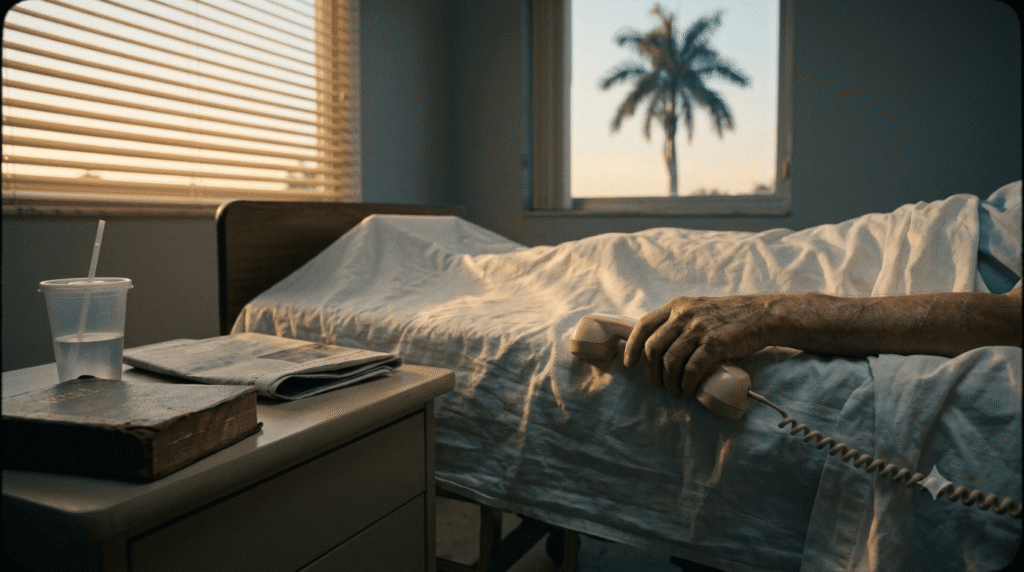
A Man Picks Up the Phone From a Hospital Bed
I read the court filing twice before I understood what I was actually looking at.
It was January 2025. A man was lying in a hospital bed outside Lakeland, Florida, his body wrecked from a motorcycle accident that had nearly killed him and his daughter. He had been free for less than a year — free, but not yet cleared. Thirty-six years of his life had gone to a Florida prison, for a murder that took place in 1987, when he was twenty-one.
The woman who died was his wife, Michelle. She was eighteen. She never got to be anything older than that.
In the previous installment, we traced a different kind of debt — one that outlived the person keeping track of it. This one is still being kept.
From the hospital bed, still recovering, the man made a call. Not to a lawyer. Not to his daughter, who had been injured beside him. He called a different prison, where a man named Jeremy Scott was serving a life sentence for an unrelated killing — the same man who had spent years confessing, on the record, to Michelle’s murder.
Leo Schofield did not call to accuse him.
He called to thank him.
What Thirty-Six Years of Court Records Actually Show
Michelle Schofield left her restaurant job in Lakeland on February 24, 1987, and called her husband to say she was almost home. She never arrived. Her body was found three days later in a drainage canal near an old phosphate pit (Innocence Project of Florida, 2024).
No forensic evidence at trial — no fingerprints, no blood, nothing recovered at the scene — connected Leo Schofield to her death. What secured his 1989 conviction was circumstantial: a temper the neighbors remembered, a witness who reported seeing him drag something heavy to his car that night, and a jury asked to close the distance between those facts and a verdict.
The case sat untouched for fifteen years. In 2004, fingerprints lifted from Michelle’s abandoned car — never run against a national database at the time of trial — were finally matched. They belonged to Jeremy Scott, already serving life for a separate killing in the same county. Beginning around 2016, Scott confessed to Michelle’s murder repeatedly, to investigators and later to the journalist Gilbert King, whose podcast Bone Valley turned the case into a national story (Fox News, 2025). One court nonetheless found his account “entirely incredible and unreliable” (ABC News, 2024). Schofield was denied parole four times before a board finally released him on April 30, 2024.
It matters to be exact about what that release was. Schofield was paroled, not exonerated. Florida law still, on paper, records him as guilty. His attorneys continue to pursue the finding his release did not grant him: a formal statement that the state got it wrong.
Jeremy Scott did not live to see that question resolved either way. He died in his cell in September 2025, of heart failure, at fifty-six. He never withdrew the confession.
A Ledger Joseph Chose Not to Collect
There is an older account of a man discovering that the people who ruined his life are now, unexpectedly, within his power.
Joseph’s brothers had sold him into slavery as a boy and told their father he was dead. Decades later, starving, they traveled to Egypt and stood before the official who could feed them or turn them away — not knowing he was the brother they had betrayed. He recognized them before they recognized him. He held, in that room, every means of settling the account in his own favor.
“You meant evil against me, but God meant it for good.” (Genesis 50:20, paraphrased)
He did not tell them the wrong hadn’t happened. He simply declined to collect on it, and fed them instead — the ancient text’s word for what he surrendered is closer to reckoning than to punishment, a claim laid down rather than a crime erased.
“Be tenderhearted, forgiving one another, as God in Christ forgave you.” (Ephesians 4:32, paraphrased)
Joseph and Schofield are not the same story, and the differences matter more than the similarities — a famine and a family’s survival on one side, a courtroom and a state that has not yet admitted its error on the other. What connects them is narrower than equivalence: both men arrived, by entirely different roads, at a moment where suffering had handed them the power to collect a debt from the person who caused it, and both set the claim down without pretending the debt was never owed.
That distinction — forgiving a person without absolving the wrong — is easy to state and hard to live inside.
Three Separate Obligations, and the One He Released
According to the National Registry of Exonerations, a project run jointly by the University of Michigan and Michigan State University law schools, people exonerated in 2025 lost an average of more than fourteen years each to wrongful imprisonment — over 1,300 years combined, across fewer than a hundred cases (National Registry of Exonerations, 2025). A wrongful conviction does not simply take years. It converts them into a trespass the state can describe with precision and still never actually repay.
The registry can count the years. It cannot count what happens inside a person once those years are finally handed back.
Look at what was actually owed to Leo Schofield, and notice that it was never a single account. There was Michelle’s death, which belongs to no one but her. There were his own thirty-six years, which belong to him and to no court’s ledger. And there was a third obligation, distinct from the first two: the state’s unresolved duty to say, formally, that it was wrong. That third debt is what survives inside the phrase “paroled, not exonerated” — a gap between freedom and innocence that no parole board is equipped to close, and that a recent piece on this site described from a different angle: reconciliation that arrives before the truth has been fully spoken (Reconciliation Without Truth).
He could release one of those obligations without releasing the other two. Forgiving Scott did not mean forgiving the institution. It did not mean Michelle mattered less, or that a confession settles every remaining fact, or that Schofield stopped asking for the exoneration his release still withholds. In the pattern this text keeps returning to, forgiveness was never a synonym for absolution. It was closer to what an earlier essay on this site called the surfacing of a hidden wrong — the naming of a trespass that still leaves the trespass named (Hidden Sin), even after the person who committed it has been personally forgiven.
What the System Never Got to Decide
Jeremy Scott is buried now, past the point where he could add to or subtract from what he said. Leo Schofield is still waiting, four decades late, for a legal system to formally distinguish between the freedom it eventually granted him and the innocence it still has not.
I read the court filing twice before I understood what I was looking at — a phone call that should have held nothing but grief and anger, used instead to say thank you. It settled no case. It closed no ledger the state still owes him.
Sources: Innocence Project of Florida, “Leo Schofield” case record, 2024. · Fox News, “After decades in prison, Leo Schofield seeks exoneration as killer confesses,” 2025. · ABC News, “Man convicted of wife’s 1987 murder shares first days with family outside of prison,” 2024. · National Registry of Exonerations, University of Michigan Law School / Michigan State University College of Law, 2025 Annual Report.
New essays every week. Delivered quietly.