Nine People, A Hundred Animals, One Order to Leave
Near Vernon, British Columbia, in the first week of August 2026, wildfire pushed close enough to Sweet Pea Farms that an evacuation order was issued for the property. Nine people stayed anyway.
There were more than a hundred animals on the land — pigs, ducks, horses, dogs — and no way to move all of them before the fire arrived. Someone would have to decide which ones came out first, and someone would have to stay long enough to do the carrying.
The order was not ambiguous. Neither was the responsibility the family felt toward the animals still standing in the barn.
An evacuation order can tell you what a fire requires. It cannot tell you everything you are responsible for.
That gap — between what danger demands and what a person still owes — turns out to be very old. It shows up in a mountain pass in northern Greece in 480 BC, in Gideon’s field outside a Midianite camp centuries before that, and in a prophet convinced, wrongly, that he was the last faithful man left.
The Retreat Leonidas Ordered First
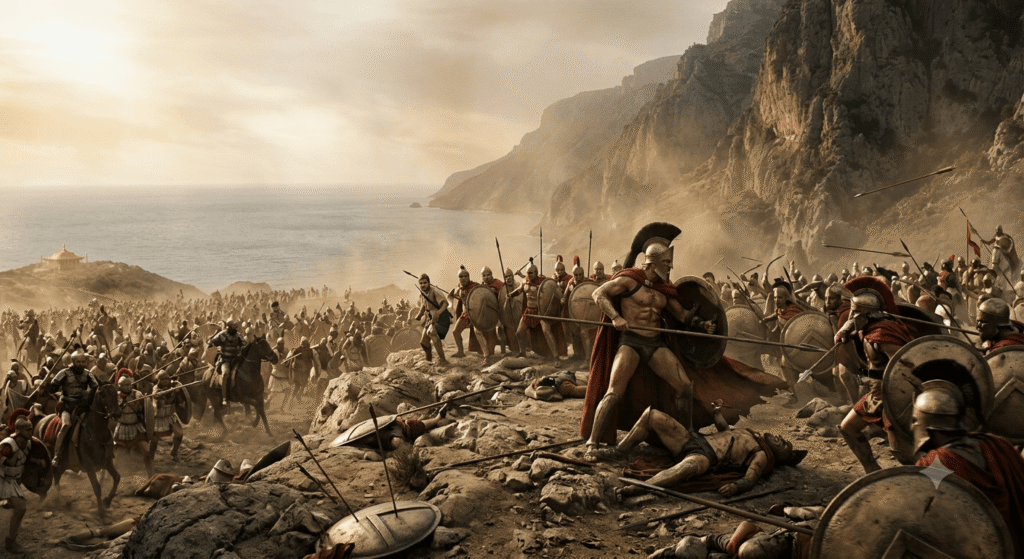
The story most people carry about Thermopylae is the wrong shape. It is the shape a film gave it — spears, oiled abdomens, a doomed and glorious last stand against impossible numbers. The real story is stranger than that, and more useful.
In August of 480 BC, a Persian army under Xerxes moved south into Greece, and a small coalition force — Spartans, Thespians, Thebans, and contingents from several other city-states, numbering in the low thousands — took up position at Thermopylae, a coastal pass narrow enough that a small force could hold back a much larger one, at least for a while (Cartledge, 2006).1 For two days, they did exactly that.
Then a local man named Ephialtes showed the Persians a mountain track circling behind the Greek position. The pass could no longer be held. Here is the detail the poster skips: once Leonidas learned the position had been turned, he ordered most of the allied force to leave. Not in shame — there was no longer a military reason for thousands of men to die holding ground already outflanked.
The retreat was Leonidas’s decision before it was anyone else’s.
He remained, with his three hundred Spartans, roughly seven hundred Thespians who chose to share their fate rather than withdraw with the rest, and some four hundred Thebans whose loyalty Sparta’s allies had reason to doubt — men Herodotus suggests were kept rather than volunteered, and who surrendered before the final assault. The legend flattens all three groups into one undivided stand. The record doesn’t.
Herodotus, writing within living memory of the battle, records more than one explanation circulating at the time for why Leonidas himself stayed — that Sparta’s honor required it, that holding the pass a little longer would buy the retreating Greeks time, that custom bound a king to his post in a way it did not bind an allied soldier. Herodotus does not settle on one; later historians have weighed the explanations against each other ever since.2
They were killed to the last man. A monument was later raised near the site, inscribed with an epitaph tradition credits to the poet Simonides:
“Go tell the Spartans, stranger passing by…”
— recording, in the lines that follow, that they had kept faith with what their city asked of them.
None of that is a story about winning. And none of it is equivalent to a farm in British Columbia. A king ordering a rearguard action is not the same as nine people staying behind for animals that cannot save themselves. The situations are not equivalent. The question underneath them is.
Not Who Stayed, But Who Was Left
Scripture’s clearest version of this pattern isn’t really about staying at all. It’s about who remains once obedience has already reduced the number.
Before Gideon ever faced the Midianites, God told him his army was too large — not too small. Thirty-two thousand men had gathered, and the instruction was to send most of them home, twice, until three hundred were left.
“With the three hundred men that lapped I will save you…” — Judges 7:7
The men who remained were not the bravest or most zealous by any test Gideon applied. They were simply what was left once everyone who could reasonably be sent home, was.
Elijah’s version runs the opposite direction — not God narrowing a number, but a man miscounting one. Convinced he is the only faithful man left in Israel, Elijah gets an answer that isn’t comfort so much as correction:
“I reserve seven thousand in Israel…” — 1 Kings 19:18
people whose loyalty Elijah had no way of seeing from where he stood. The remnant was never as small, or as visible, as the man inside the crisis assumed.
Isaiah names the pattern outright, writing to a nation that has learned what it costs to trust the wrong things — that a remnant will return, not because it is the strongest part of what was lost, but because it is what is left once everything that could be shaken already has been.3
The text does not condemn the ones who went home from Gideon’s army, or the seven thousand Elijah couldn’t see. They obeyed exactly what was asked of them.
The farmers at Sweet Pea Farms chose to stay. Gideon’s three hundred did not choose anything — they were what remained after choice had already been made for them, twice. That difference is the paradox worth sitting with: a remnant is not always the part that decided to remain. Sometimes it is only what obedience, or circumstance, or a fire line, happened to leave behind. What both share is what comes after — the number is set, and only then does its weight become visible.
What the Order Doesn’t Decide For You
Across British Columbia that week, most people under evacuation orders left. They should have — wildfire agencies have more information about a fire’s behavior than any individual property owner ever will, and in the overwhelming majority of cases, leaving is not the lesser choice. It is the correct one.4
The question was never whether leaving was right. It was what a person does with the one thing the order doesn’t cover — the animal, the field, the oath — once the general instruction has already been obeyed by everyone with sense.
An evacuation order assumes an autonomous person, someone capable of understanding the instruction and acting on it. A herd of animals is not that. It cannot read a warning, cannot drive itself anywhere, cannot weigh a fire line against its own survival. That dependence is what turns a fire story into a story about care rather than courage — the moment someone realizes that leaving would mean deciding, on the animals’ behalf, that they weren’t worth the risk.
This isn’t the older, simpler courage of walking toward danger for its own sake. It’s a quieter and arguably harder version — the kind that appears only when care for something already built outweighs the risk of staying near it. Call it what it is: not the absence of fear, but a loyalty that outlasts the reasonable argument for leaving.
It is one thing to ask what the law required. It is another to ask what prudence required. It is a third thing entirely to ask what love required of the people already standing there. Those three questions don’t always return the same answer, and most human tragedy lives in the gap between them. We’ve traced that gap from a different angle before — what happens when the law’s answer and the true one diverge entirely — and it shows up here too, quieter but no less real: the law can tell you what is permitted. It cannot tell you what you are owed to carry.
Gideon’s three hundred never chose to be small; the number was chosen for them, twice, by an instruction they didn’t write. Leonidas chose his own reduction, then stayed inside it. The farmers at Sweet Pea Farms didn’t reduce anyone — they simply refused to let the order define the whole of what they owed. The moral question was never how many remained. It was what they remained responsible for.
What Remains When the Order Has Done All It Can
No order, ancient or current, settles what a person does with what they are specifically responsible for — it only tells them what the danger requires. Leonidas gave that order himself, then chose what he still owed inside it. The nine people at Sweet Pea Farms weighed a fire line against animals that couldn’t weigh it themselves. Gideon’s three hundred never chose the space at all; they were simply what remained once obedience had finished its work.
In the previous installment, we asked what a stranger’s need requires of someone with no formal claim on them — a debt no one asked us to owe. This week runs the same question the other direction: not what we owe those with no claim on us, but what we still owe the ground and the animals and the oath already standing under our feet before any order arrives to test it.
1. Cartledge, Paul. Thermopylae: The Battle That Changed the World. Overlook Press, 2006.
2. Herodotus, The Histories, Book VII (trans. A.D. Godley, Loeb Classical Library edition).
3. Isaiah 10:21.
4. Canadian Press, “Why some B.C. farmers stay to fight, despite wildfire evacuation orders,” Aug. 8, 2026 — as of that week, 221 agricultural properties in the province remained under evacuation order.
New essays every week. Delivered quietly.