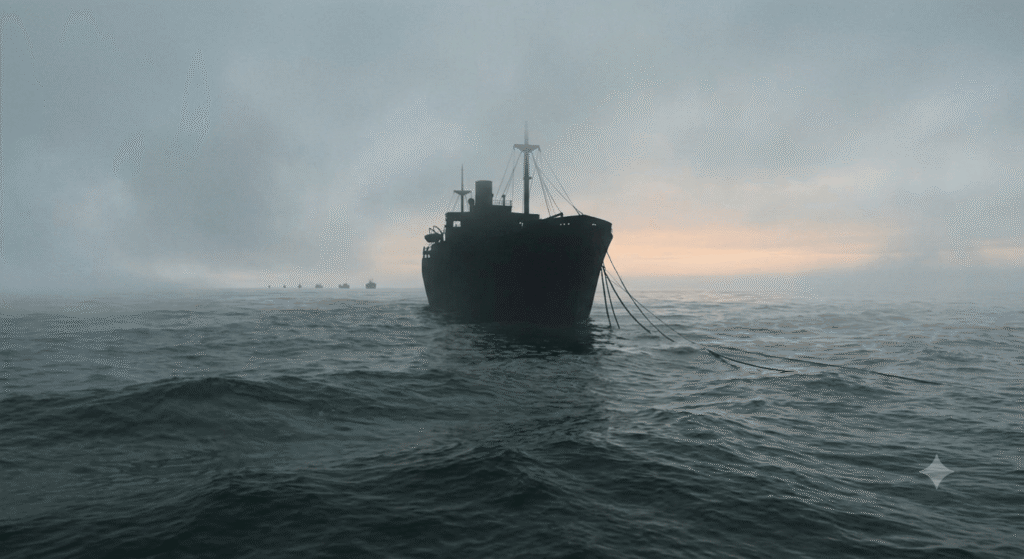
The Sixty Seconds Before the Decision
A captain sometimes has less than a minute to decide whether saving a stranger is worth turning his own ship into a target.
That is the plain arithmetic of a convoy at war. The rule, drilled into every merchant crew crossing the North Atlantic in 1943, was simple and unsentimental: if a ship near you goes down, you do not stop. You keep your station, you keep your speed, and you let the escorts — the destroyers, the corvettes, the one vessel in the convoy specifically built and staffed for exactly this task — handle the men in the water. A stationary ship is a gift to whatever submarine put the first torpedo into your neighbor. Everyone on the bridge knows this. It is printed in the convoy instructions. It is repeated at every briefing, in every port, before every crossing.
And then, every so often, a captain looks at the men in the water and decides the arithmetic doesn’t apply to him today.
Two days ago, this space sat with a different kind of staying — the discipline of remaining somewhere when no rescue is coming (Staying When Help Doesn’t Come). This week the question turns around. What does it cost to be the rescue that comes — when showing up might be the last thing your ship ever does?
In the gray hours before dawn on March 7, 1943, an ordinary freighter with no special equipment and no training for the work was given an order that answered that question for her. What her crew did with that order — carried it out, in full, in the one stretch of ocean where carrying it out was almost certain to get them noticed — is worth sitting with. She is not a famous ship. Almost no one has heard her name. But most of us will get a version of her morning eventually — smaller, quieter, without the torpedoes, but recognizably the same arithmetic: an order or an obligation lands on you, and the danger in carrying it out doesn’t shrink just because someone else decided it was yours to carry.
It rarely announces itself as a moral test in the moment. It shows up disguised as a schedule, a fuel gauge, a meeting already running late, a perfectly reasonable reason to keep going. Nobody on Empire Impala’s bridge that morning would have described what they were doing as an ethical decision. They would have called it looking at men drowning in freezing water and doing the only thing that made sense to do next. The theology, if there was any, came later — to whoever survived long enough to write it down.
Nine Days of Storm, One Morning of Silence
Convoy SC 121 had already survived more than it should have by the time anyone fired a torpedo at it.
The convoy — some fifty-nine merchant ships, mostly slow freighters loaded with the raw material of a war three thousand miles from home — left New York on February 23, 1943, gathering off Sydney, Nova Scotia, before turning east toward Liverpool. Its escort was the Mid-Ocean Escort Force’s Group A-3: the American cutter USCGC Spencer, the destroyer USS Greer, four Allied corvettes, and one ship built for a single purpose — the designated rescue vessel Melrose Abbey, fitted with scrambling nets, an operating room, and berths for a hundred and fifty men who were not supposed to need them yet.
The rescue ship program that produced vessels like Melrose Abbey existed because the Admiralty had already learned, the hard way, that leaving rescue to chance did not work. Early in the war, the job of pulling survivors from the water had simply fallen to whatever merchant ship happened to be nearest — and most captains, understandably, refused to fall out of formation and drift as a stationary target while the convoy steamed on without them. Warships did the job more often instead, but every minute a destroyer or corvette spent fishing men out of the sea was a minute it was not screening the rest of the convoy from whatever had just attacked it. By 1941 the solution was to build ships for the sole purpose of stopping: enlarged galleys, extra berths, scrambling nets along the hull, a doctor on board. Melrose Abbey was one of thirty such ships eventually built or converted across the war. Empire Impala was not one of them — she was an ordinary cargo freighter, unequipped for the work. That did not exempt her from being handed it.
They needed the rescue apparatus almost immediately, though not from the enemy. Nine straight days of Force 10 gales tore the convoy apart before a single U-boat found it. Snow squalls cut visibility to nothing. Three of the escorts lost sonar. Three others lost radar. The escort commander’s own radio failed in the weather, which meant that by the time the German submarine U-405 finally sighted the scattered ships on March 6, the convoy’s ability to warn itself had already been half-destroyed by the ocean, before the Germans had done anything at all.
At 02:10 on the morning of March 7, U-230, under Kapitänleutnant Paul Siegmann, put a torpedo into the British freighter Egyptian.
What happened next is recorded almost clinically in the Admiralty’s own casualty files: Empire Impala, in convoy alongside her, was ordered to pick up Egyptian’s survivors.3 An order is a short thing to write down. Carrying it out was not. It meant hove-to, engines idling, in open ocean, in the dark, in a convoy that had already proven — three lost sonar sets, three failed radars, a dead radio — that it could no longer reliably track where the danger was. The order gave Munford a reason to stop. It did not give him a reason to stay stopped once the search dragged past the point of good sense, and no one aboard would have been blamed for cutting it short in that weather, in that visibility, with a U-boat concentration already reported nearby. Her master, Thomas Henry Munford, and her crew stayed with it anyway, because there were men in the water who were not going to survive without it.
Empire Impala was, by any measure, an unremarkable ship for the job: 6,116 tons, built in 1920 at a shipyard in Alexandria, Virginia, renamed three times and sold twice before the British Ministry of War Transport requisitioned her and gave her the name she would die under. Nothing about her construction made her better suited to a rescue than any other freighter in the line. She was simply the one the order landed on.
The North Atlantic in early March gave a man in the water very little time. Pulling someone out of it was not a symbolic gesture. It was a race measured in the same currency as the danger — minutes a stopped ship spends motionless with her engines idling, while a convoy that has already lost track of where the enemy is keeps moving on without her.
Something was watching. Kapitänleutnant Hans-Jürgen Zetzsche, commanding U-591, had returned to patrol only recently, still recovering from gunshot wounds sustained on an earlier voyage. At 09:06 that morning he torpedoed a straggler from the convoy — almost certainly Empire Impala, hove-to and lit by the flat gray light of a subarctic dawn, exactly where the order had put her.3 Her own complement of forty-eight — Munford, forty-one crew, six naval gunners — went down with the ship. There were no survivors. Some of the men she had just pulled from Egyptian’s wreck, according to the record kept at London’s Tower Hill Memorial, went down with her too — men who survived one sinking only to be lost in the next, within the same morning.3
The storm was not finished, and neither were the two U-boat groups Dönitz’s staff had assembled to hunt the convoy — Wolfpack Westmark and Wolfpack Ostmark, more than two dozen boats between them. Over the following three days, stragglers scattered by the gale were picked off one at a time — Empire Lakeland, the Swedish freighter Milos, the Norwegian Bonneville, the escort oiler Rosewood, the ammunition ship Malantic — until reinforcements reached the convoy from Iceland and the survivors of SC 121 finally limped into Liverpool on March 14. Twelve merchant ships were gone, along with two tank landing craft being carried across as deck cargo. Two hundred seventy men were dead or missing. Of the two hundred seventy-five crew aboard the ships that sank, only seventy-six were ever recovered.1
None of that arithmetic changes what happened at dawn on March 7. A ship carried out the order she was given, in the one stretch of ocean where carrying it out was almost certain to get her noticed.
The Unmapped Duty
Ancient Israel had no U-boats, but it built the same problem into its law.
Scripture does not treat the obligation to the stranger as optional, or as something specially assigned to whichever official happens to be equipped for it. It keeps landing on whoever is nearest when the need appears. In Luke’s Gospel, a lawyer asks Jesus who, exactly, counts as his neighbor — hoping, most readers agree, for a definition narrow enough to manage. The answer he gets is a story instead of a boundary line: a traveler is left half-dead on a desert road, and the two men with every institutional reason to keep walking — a priest, a Levite, both bound for duties that arguably mattered — do exactly that (Luke 10:25–37). It is a third man, a Samaritan, with no professional obligation and every social reason to keep moving, who stops. He does not delegate the wound to someone better positioned. He binds it himself, and he pays for the stranger’s recovery out of his own pocket.
The parable does not need us to settle the priest’s and the Levite’s motives to make its point. Temple service carried real obligations, and a man who touched a corpse on the road home would have made himself ritually unfit for it — their hesitation likely had a logic behind it, a competing good, not simple cowardice. The story’s discomfort comes from something narrower: whatever their reasons, the need in front of them did not go away because someone else had a defensible reason to keep walking.
“Greater love hath no man than this, that a man lay down his life for his friends.” — John 15:13 (KJV)
The verse is usually read as a description of the cross, and it is that, first of all. It says nothing about who does or doesn’t count as a friend. What it fixes on is narrower and harder: what the love that counts is willing to cost the one who offers it.
“Hereby perceive we the love of God, because he laid down his life for us: and we ought also to lay down our lives for the brethren.” — 1 John 3:16 (KJV)
We ought. The sentence does not open by asking whether we are equipped for the obligation. It opens already assuming the obligation, and leaves the equipping for later — or never. That is, notably, the same maneuver Empire Impala’s own order performed: it did not wait for her to be a rescue ship before making the rescue hers. A rulebook can tell a captain what is safest. It has never yet managed to tell him what is owed.
The Bible refuses to hand readers a formula that turns every wreck into a verdict from heaven, and this essay makes no claim about why one ship sank and another one, somewhere else that same week, did not. What the record does seem to insist on, patrol after patrol, morning after morning, is that a people’s real character surfaces in what they are willing to carry through once the cost of carrying it becomes real — and that this has been true since long before anyone strapped a torpedo tube to a hull.
The Residual Cost of Compassion
By the time the war ended, the Admiralty had built or converted thirty dedicated rescue ships. Between them, across nearly eight hundred convoys, they pulled 4,194 survivors out of the sea from 119 sunk vessels — and lost seven of their own number doing it, three to U-boats and three to aircraft.2
Those figures are, by any measure, an extraordinary institutional achievement: a navy that decided, in the middle of a war it had not yet won, to build ships whose entire purpose was saving men from ships that had already lost. But read the numbers again and a gap appears. Thirty rescue ships, spread across the whole North Atlantic, could not be everywhere a torpedo landed. The ocean was too large, too violent, and too well hunted for any fixed system to cover every sinking — which meant a meaningful share of the men pulled from that water in those years owed their lives not to a Melrose Abbey but to an Empire Impala: an ordinary freighter that had simply been close enough when the order came, and unequipped for the job it was handed.
There is a modern version of the same gap, and it has nothing to do with ships. A well-documented finding in social psychology, first traced by John Darley and Bibb Latané in 1968, is that the more people who are in a position to help, the less likely any one of them does — responsibility, once it can be shared, tends to diffuse until it belongs to no one in particular. Systems reduce that effect. They can also, without meaning to, make it easier to assume the job has already been claimed by someone better positioned.
The Admiralty could institutionalize compassion up to a point. It could not fully outsource it. Somewhere past the edge of every system, a person still has to look at the water and decide it is theirs to answer. The shape of the system has changed since 1943 — fewer convoys, more call centers, dashboards, and automated routing — but the edge it leaves uncovered has not gone away. It has just gotten better at looking covered.
That gap is where the biblical pattern lives most uncomfortably, and where it is least willing to let the reader off the hook. The law given at Sinai built rescue into the structure of Israelite society on purpose — grain left standing at the edges of fields for the poor and the foreigner to glean, cities of refuge for the wrongly accused, a tithe every third year set aside specifically for the widow, the orphan, and the stranger (Deuteronomy 24:19–21). It attempted something structurally similar to the rescue ship program: making care for the vulnerable part of a community’s ordinary rhythm rather than something that depended on an occasional act of heroism. And still the law kept circling back to the individual conscience, because no system, ancient or modern, has ever managed to make compassion fully automatic. Someone still has to be the one who stops the plow, or the ship, or the car, or the conversation, and decides that this — right now, this stranger, this cost — is theirs to carry.
It is tempting to read that as a case against systems altogether, but the record does not support it. The convoy escort system, gale-damaged and undermanned as it was during those nine days in March, still brought the great majority of SC 121’s ships home. The rescue ship program, however incomplete its coverage, still accounts for over four thousand men who would otherwise have simply frozen in the water waiting for a stranger’s decision that might never have come. Structures matter. They catch most of what individual conscience alone would eventually drop. But they were never designed to catch everything, and the gap they leave behind is not a flaw to be engineered away so much as a space scripture seems to expect will always exist — the space an ordinary freighter fills, or doesn’t, on an ordinary Tuesday morning.
The Empty Space Where a Ship Used to Be
Empire Impala has no film, no monument beyond a name on a memorial wall, no plaque marking the patch of gray Atlantic where she went down with the men she had just pulled aboard. Most searches for her turn up little more than a line in a convoy record and a cross-reference to the ship whose crew she died trying to save. She was not decorated for it. There was, in 1943, no ceremony built for freighters that carried out an order like this one and paid for it in full.
That absence is, in its way, the most honest ending this particular story can offer. Nothing about the outcome argues that the order was the strategically correct one, or that carrying it out will always turn out to matter, or that the sea rewards the ship that stops. It sank her. Some of the men she had just pulled from Egyptian’s wreck were lost anyway, within the same hour, in the same cold water they had just been pulled from once. So was Thomas Henry Munford, her master, and the forty-seven men under his command.
And still, on a morning when every rule and every instrument on her bridge argued for staying underway, Empire Impala’s crew did what the order asked of them. Not because the odds favored it. Not because anyone on board got to find out, later, whether it had mattered. Because there were men in the water, and for one gray hour in March, the distance between the ship and them was the only fact left that did.
The sixty seconds every captain on that crossing carried never really closed after 1943. They just moved inland — into hospital corridors, into the space between a phone ringing and someone deciding whether to answer it, into every ordinary morning where the convenient thing and the necessary thing happen to point in opposite directions. Empire Impala never got to find out whether stopping was worth it. Most people who make that choice never do. They make it anyway, and the record — or the silence afterward — decides the rest.
1 Crew casualty and rescue totals for Convoy SC 121 draw on Jürgen Rohwer and Gerhard Hummelchen, Chronology of the War at Sea 1939–1945 (Naval Institute Press, 1992), and Samuel Eliot Morison, History of United States Naval Operations in World War II, Vol. I: The Battle of the Atlantic 1939–1943 (Little, Brown and Company, 1975).
2 Rescue ship service totals — thirty ships, 797 convoys, 4,194 survivors, seven ships lost — are drawn from Arnold Hague, The Allied Convoy System 1939–1945 (Naval Institute Press, 2000).
3 Details on Empire Impala’s master, complement, and the timing of the attacks on Egyptian and Empire Impala are drawn from the Allied ship-loss database at uboat.net, compiled from Admiralty casualty and loss records.