Hook
A Name Outlasts a Face
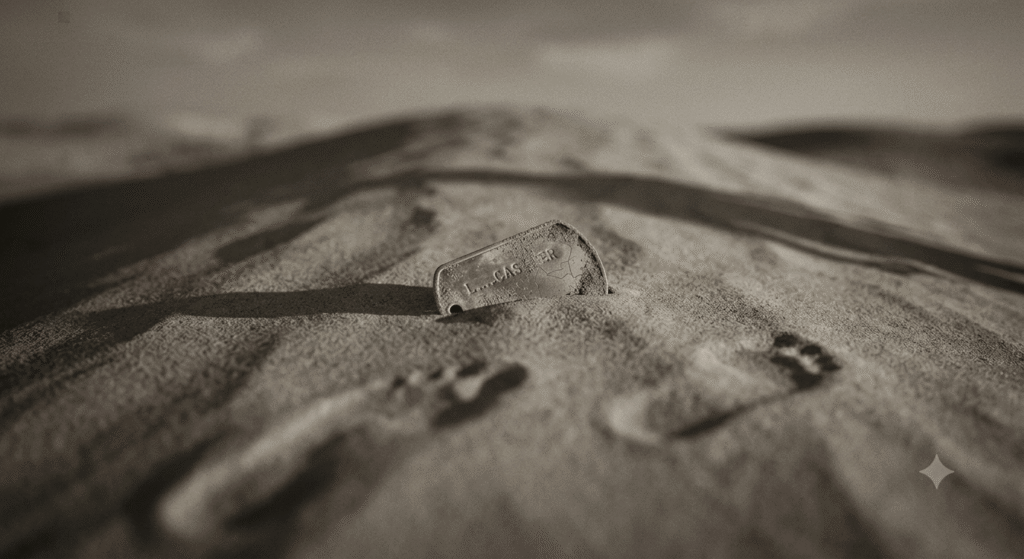
In late August 2026, the Defense POW/MIA Accounting Agency confirmed the identity of a pilot who went down over Egypt during the fighting at El Alamein on November 2, 1942. Captain Marvin Lancaster was twenty-four. British forces recovered a set of remains five days after the crash, but not enough to attach a name to them — so the file stayed open for eighty-three years.
The evidence had survived. What had been missing was the ability to read it. DNA sequencing accomplished in a laboratory what eight decades of searching had not: it matched a fragment of bone to a family that had never stopped waiting for one. Lancaster will be buried next month, under his own name, in the place he last knew as a young man.
We’ve followed a version of this pattern before — DNA evidence overturning a conviction decades after the fact, a different kind of file staying open a different kind of long. The shape repeats: something isn’t destroyed, it’s just unread. What interests me here isn’t the science. It’s the eighty-three years in between — the long middle where a person is neither found nor forgotten. Just held.
The English Patient (1996) opens in something like that middle. A man is pulled from a burning plane in the North African desert so disfigured that no one — least of all himself, for most of the film — can say who he is. He’s carried to a bombed-out Italian villa, where a nurse named Hana stays behind after everyone else has moved on. She changes his bandages. She reads to him. She does this before she knows his name, and keeps doing it after she learns why he’s been avoiding it.
History
What a Map Cannot Forget
The film’s central figure, Count Almásy, is loosely drawn from a real member of a 1930s desert-exploration circle — amateur cartographers who spent years filling in blank stretches of the Libyan Desert for the Royal Geographical Society, chasing a legendary lost oasis and, more usefully, mapping water routes no one had recorded before. The film reshapes him considerably; the historical Almásy and the character on screen share a name and a desert, not much else.
What the history does confirm is stranger than the fiction needs it to be. That same terrain knowledge — gathered for scholarship, out of something close to affection for the land — was later used to help guide foreign intelligence agents across the desert into Cairo, an operation historians know as Salaam.1 His maps didn’t change between 1938 and 1942. Nothing about the map changed. Only what it was asked to reveal did.
Lancaster’s story has no actual connection to Almásy’s — this is a thematic echo, not a shared history. But the echo holds: one man knew the desert well enough to be useful to it. The other became something the desert kept, without being asked.
Scripture
Hidden Is Not the Same as Lost
It’s worth being precise here, because the words we reach for aren’t interchangeable. Something lost is simply unlocated — no intent involved, on anyone’s part. Something forgotten has faded from memory without necessarily being gone from the record. Something hidden or concealed was put out of view on purpose, by someone.
Lancaster was lost. He was not hidden, and nothing about his story involves concealment or wrongdoing. That distinction matters, because Scripture’s language about secrets tends to assume the second category:
“Be sure your sin will find you out.” — Numbers 32:23 (KJV)
That line was spoken to tribes about to cross the Jordan, warning them what would happen if they broke a specific promise to their own people — it’s about accountability inside a community, not a general law of physics for anything ever buried. Two more places in Scripture return to a related but distinct idea — that time itself doesn’t erase what’s real, whether or not anyone meant to hide it:
“For nothing is secret, that shall not be made manifest.” — Luke 8:17 (KJV)
“Thou hast set our iniquities before thee, our secret sins in the light of thy countenance.” — Psalm 90:8 (KJV)
Scripture doesn’t ask readers to treat every recovered grave, every closed file finally reopened, as a verdict handed down from heaven. It does suggest that what a person, or a people, are willing to leave unsettled — and for how long — says something about the account they were content to live with.
History can tell us what happened to Lancaster: his remains went unidentified for eighty-three years and now aren’t. Faith poses a harder question: What does it mean to believe a person can vanish from human history without being erased from divine memory? Scripture doesn’t offer a tidy answer to that. It offers a recurring instinct that human memory and final memory aren’t the same thing, without ever fully explaining the gap between them.
Pattern
What Eighty-Three Years Means
Nearly 72,000 American service members from World War II are still listed as unaccounted for.2 In the fiscal year now ending, DPAA has positively identified 168 of them — Lancaster among the most recent.3 The math is sobering less for the total than for the pace: at this rate, most of the 72,000 will stay exactly as they are.
The missing years were not empty years, though. Records were kept. Case files stayed open in filing cabinets nobody expected to reopen. Laboratories developed sequencing techniques that didn’t exist when Lancaster’s parents were still alive to wonder about him. None of that activity looked like searching, most of the time. It looked like paperwork. It was, in its slow way, someone’s decision not to let a name close.
That’s closer to what Hana does than a plot summary suggests. She isn’t solving a mystery. She’s caring for a man whose name she doesn’t have yet, on the theory — never stated, just practiced — that a person doesn’t become worthy of care the moment we discover who he is. The identity, when it surfaces, doesn’t retroactively earn him the bandages already changed or the books already read aloud. Those came first.
Closing
The Name That Remained
Next month, a family in a town Lancaster last saw as a young man will bury him with his rank and squadron restored to his name — details the desert never actually erased, just declined to hand over. What survives, in the end, when everyone who once remembered a person firsthand is gone? Records survive imperfectly. Memory survives even less well. Something in both Scripture and this particular week in Egypt’s long war suggests the ledger doesn’t close there.
The desert did not surrender the man. It surrendered his name.
1. Bierman, J. (2004). The Secret Life of László Almásy: The Real English Patient. Pen and Sword Books.
2. National WWII Museum, citing Defense POW/MIA Accounting Agency figures (as of early 2026).
3. Defense POW/MIA Accounting Agency (DPAA), Accounting Progress & Identification Data (FY2026); as reported by WITN News, August 24, 2026.
New essays every week. Delivered quietly.