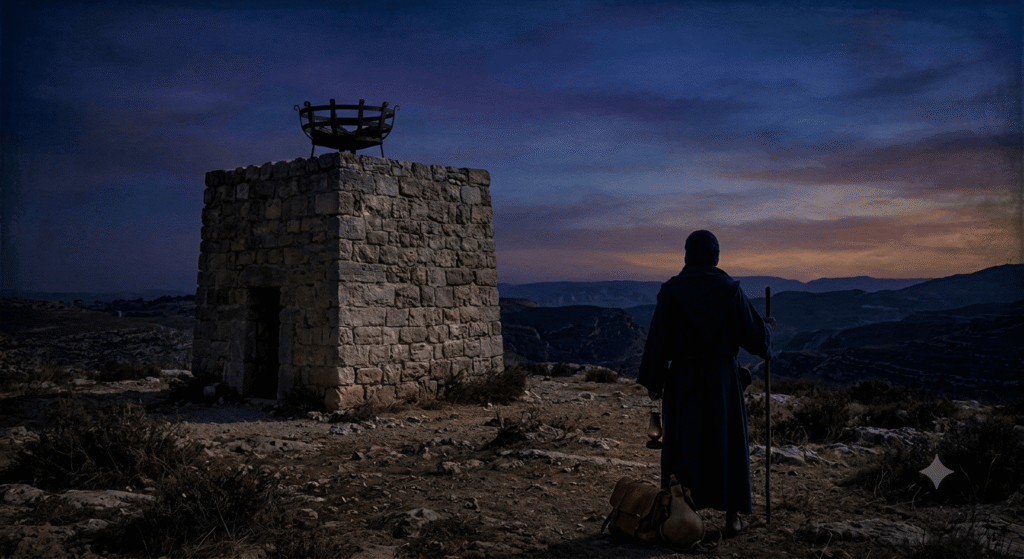
Fourteen Hours of Not Knowing
On July 8, 2026, a lightning strike hit a transmission line near Wolcott, Colorado, and cut power to twenty-seven thousand customers from Vail to the Roaring Fork Valley. AT&T and T-Mobile subscribers lost phone service, text alerts, and internet entirely for the outage’s full fourteen hours. Verizon customers kept a thin signal.1
It happened during fire season, in a valley where a wildfire evacuation could depend on exactly the alerts that had just gone dark. For fourteen hours, plenty of people in that valley had no way to confirm whether the next town over was fine, on fire, or something in between.
A power failure interrupts convenience. A failure of information interrupts something closer to a person’s sense of orientation.
That particular fear — watching for a signal and getting nothing back — is old enough to have left a paper trail. Literally. In the guardroom of a gate in Judah, twenty-six centuries before Wolcott lost its cell towers, a soldier wrote down the exact same thing.
The Letter That Was Never Answered
In 1935, archaeologist J.L. Starkey was excavating the gate complex of Lachish when his team found a cache of inscribed pottery fragments in a burned guardroom — letters, ink on broken clay, dated by context to the final weeks before the city fell to Nebuchadnezzar’s army in 586 BC.2 They’re known now as the Lachish Letters, and one of them, Ostracon IV, has become one of the most quoted military documents in ancient Near Eastern history.
It was written by an officer — almost certainly the same man, Hoshaiah, who signs several of the other letters in the batch — to his commander, Yaosh, the garrison officer at Lachish. Hoshaiah reports that he is watching for Lachish’s own signal fires exactly as instructed.
Azekah sat within sight of Lachish, across the low hills of the Shephelah — near enough that a fire lit at one gate could, on a clear night, be read from the other. That’s what made the silence legible as bad news rather than static.
Then comes the line that made the letter famous:
“…for we cannot see Azekah.” — Lachish Ostracon IV
Azekah was the other fortified city still standing between the Babylonian army and Jerusalem. If its signal had stopped, the plainest explanation was the one nobody wanted to write down: Azekah had fallen, and Lachish was now the last thing standing in the way.
Hoshaiah didn’t know that for certain. He only knew what he could no longer see.
He kept writing anyway. The letters continue reporting troop movements, requesting instructions, following procedure — a man doing his job inside a communications blackout he had no power to fix, with no confirmation that any of it still mattered. Lachish fell not long after. Excavated destruction layers at the site — ash, collapsed brick, arrowheads consistent with a final assault — line up with the letters almost to the week.2 Whether Yaosh ever wrote back is something the record doesn’t preserve. The last letters in the batch went unanswered.
The Cistern and the One Who Climbed Down
Scripture confirms the shape of what Hoshaiah was watching, almost in passing. Describing the same siege, Jeremiah names the two cities still holding out against Babylon:
“…for these alone remained of the cities of Judah as fortified cities.” — Jeremiah 34:7
Lachish and Azekah. The same two names on Hoshaiah’s clay fragment, confirmed independently in a different book, written by a different hand, for a different purpose.
Inside besieged Jerusalem, during that same collapse, Scripture preserves a smaller, sharper story about acting without confirmation that it will help. Officials in Zedekiah’s court had thrown the prophet Jeremiah into an empty cistern to die, judging him a threat to morale. Ebed-Melech, a Cushite eunuch serving in the royal household — a foreigner, with no obvious stake in a Judean prophet’s survival — went to the king and asked for permission to pull him out.
“My lord the king, these men have done evil…” — Jeremiah 38:9
Nothing in the text suggests Ebed-Melech knew the city would hold out much longer, or that his intervention would be remembered at all. He acted inside the same blackout Hoshaiah was writing from — no confirmation, no way to see past the walls of his own moment.
The two silences aren’t quite the same kind. Hoshaiah worked inside a system that had simply stopped answering — orders, procedure, chain of command, all still technically in place, just no longer responsive. Ebed-Melech worked inside something worse: a court that hadn’t gone silent so much as stopped caring, where the men who threw Jeremiah in the cistern were still very much in charge and still perfectly willing to talk. Acting faithfully inside a broken system is one thing. Acting faithfully inside a system that still works, just not for good, is the harder version.
Working Without a Reply
In Wolcott, the outage ended after fourteen hours, and the questions people had been sitting with — is my sister’s town okay, did the fire cross the ridge, is anyone coming — mostly resolved themselves once the signal came back. Fourteen hours of not knowing is a real weight, but it’s a weight with an edge to it. It ends.
Hoshaiah’s didn’t. As far as the record shows, he never learned whether his reports reached anyone who could act on them, never got word back from Yaosh, never found out whether the silence from Azekah meant what he feared. He kept doing the one job in front of him — watch, report, repeat — inside a blackout with no scheduled end.
That’s a harder discipline than courage under fire, because it isn’t dramatic. It’s a man refusing to let the absence of a reply change what he was responsible for doing. We’ve traced a version of that same refusal before, in a farm outside a Canadian wildfire zone — where staying meant caring for something that couldn’t confirm it was worth the risk either.
Ebed-Melech’s choice runs the same discipline from a different angle. He wasn’t watching for a signal. He was the signal — the one person in a compromised court who acted as though a forgotten man in a cistern still mattered, with nothing to gain from being right about it. That’s the same shape of risk we followed in a debt no one asked us to owe: help extended to someone with no claim on you, offered before you know if it changes anything.
Most of what people are actually responsible for gets done without a reply confirming it mattered.
What Gets Written Down Anyway
Hoshaiah’s letters survived a fire that Lachish itself did not. Ebed-Melech’s request survived in a book written by the very prophet he pulled out of the mud. Neither man wrote expecting an audience twenty-six centuries later. Both kept doing the thing in front of them anyway, inside a silence that never explained itself while they were still living in it.
In the previous installment, we asked what a person still owes once an order to leave has already been given — what a remnant is, and who decides its size. This week runs a version of the same question in the dark: what a person owes when there’s no order at all, and no way to know if anyone is left to give one.
1. “Holy Cross Energy power outage lasted 14 hours, raised many communications questions.” Vail Daily, July 8, 2026.
2. Torczyner, Harry (Tur-Sinai). Lachish I: The Lachish Letters. Oxford University Press, 1938. The reading followed here — that Azekah’s signal had gone dark — is the majority position in the epigraphic literature, though the fragmentary line has drawn alternative readings.
New essays every week. Delivered quietly.