The last offer came from a man whose name no one kept
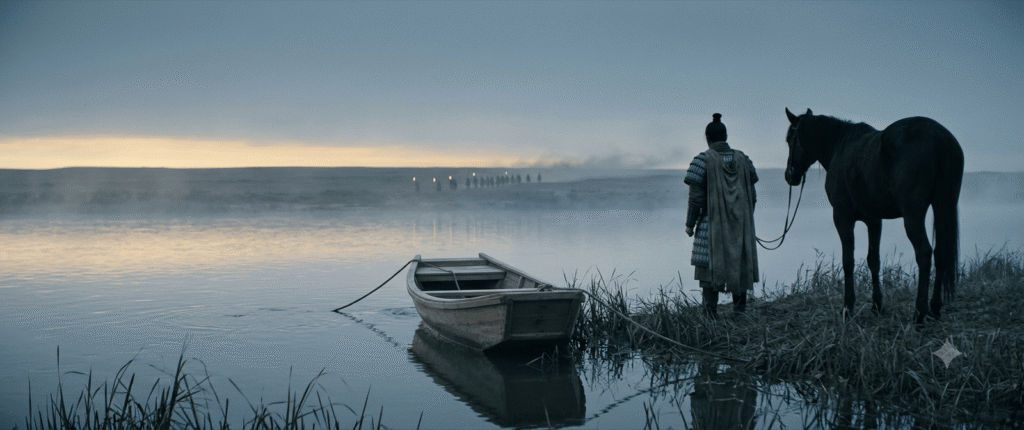
Sima Qian gives the ferryman at the Wu River an office and a boat, and no name. He keeps a river post, and on the day that matters he has brought his only vessel to the bank and waits.
The far shore is Jiangdong, homeland of the man he is waiting for. It is a small country, he says, but a king can be made from it, and the Han riders cannot follow without a boat. Xiang Yu laughs, hands over his horse, and turns back toward the pursuit.
It is a small thing to lift a foot over a gunwale. I have come to believe it was the hardest thing he was ever asked to do.
This happened in 202 BC, the same year that, at the other end of the ancient world, a Carthaginian general walked out between two armies and spoke first. In the previous installment, we followed Hannibal to that parley at Zama, where a proud man asked for terms while something remained to bargain with. This week the question runs the other way: what does a man do when passage is offered, and taking it would cost him his pride?
A night of borrowed songs, and a road that narrowed to a riverbank
After the Qin dynasty collapsed, Xiang Yu and Liu Bang spent four years contesting what remained of the empire. Xiang Yu was the more formidable commander in the field; Sima Qian has him claim, near the end, more than seventy battles without a defeat (Watson, 1993). Liu Bang was the better collector of talent. Han Xin, a junior attendant whose advice Xiang Yu never took, went over to Liu Bang and became the general who won him much of the empire.
By the closing months of 202 BC, the Chu army sat at Gaixia, short of grain and ringed on every side. Then, in the dark, the sound changed. From beyond the Han lines came soldiers singing the songs of Chu, the southern homeland of the very men Xiang Yu had marched north. He woke and asked, in Sima Qian’s telling, whether Han had already taken all of Chu, since so many Chu voices were in its camp. The idiom that grew from that night, songs of Chu on every side, still names the moment the ground goes out from under a person.
He drank and sang a short verse of his own: strength that once could uproot mountains, a season turned against him, a horse that would no longer run. The record adds that a woman named Yu, who had followed him through the war, joined the song, and that the men around them wept without lifting their eyes. The later tales of her sword dance and her death belong to ballad and stage rather than to Sima Qian’s page.
He broke out that night with about eight hundred riders. By the time he reached Dongcheng, after a crossing of the Huai and a wrong turn in a marsh, twenty-eight were left. At the Wu River a local ferry official had a single boat ready. Jiangdong is small, the man said, but it is a domain some hundreds of miles across, with people enough to make a king.
Xiang Yu refused for two reasons, and Sima Qian gives both. Heaven was ending him, so why cross? And he had once crossed that river west with eight thousand young men from Jiangdong, and not one had come home; even if their elders pitied him and crowned him, how could he look them in the face? He gave the ferryman the horse that had carried him for five years and fought on afoot. He recognized an old comrade among the pursuers, remarked that Han had put a price on his head, and ended his own life. Five of Han’s officers would share the reward. Liu Bang, the record says, buried him with a duke’s honors and wept at the grave (Watson, 1993).
A wounded king asks for an ending, and his armor-bearer cannot give it
What does a beaten man still have to protect? Scripture holds an older scene that puts the question to a different king. Roughly eight centuries before Gaixia, Israel’s first king stood in a battle he was losing.
He had begun his reign as a rescuer: in 1 Samuel 11 he broke an Ammonite siege of Jabesh-gilead, a town that would not forget it. Now the Philistines had driven Israel up Mount Gilboa; his sons were dead, and archers had found the king himself. What he feared most, the text is careful to say, was not dying but being handled by his enemies.
“…lest these uncircumcised come and thrust me through, and abuse me. But his armourbearer would not; for he was sore afraid.” (1 Samuel 31:4, KJV)
The armor-bearer’s refusal is the last mercy the scene offers, and the king does not take it as one. It is also the loneliest exchange in the chapter: a man who has commanded armies asks his own servant for the one service that cannot properly be asked, and the servant, afraid, cannot give it. Saul ends his own life, the armor-bearer follows, and the Philistines pin the bodies to the wall of Beth-shan. Then the chapter moves somewhere unexpected.
“All the valiant men arose, and went all night… And they took their bones, and buried them under a tree at Jabesh, and fasted seven days.” (1 Samuel 31:12–13, KJV)
When the news reaches David, he does not gloat; he composes a lament.
“The beauty of Israel is slain upon thy high places: how are the mighty fallen!” (2 Samuel 1:19, KJV)
The Books of Kings, which take up the monarchy’s story afterward, go on judging rulers by what they did with power rather than by what they won with it, and Saul’s last chapter already reads like the first entry in that ledger.
Scripture never insists that every disaster is a verdict from heaven. What it keeps noticing is quieter: that once the noise of a defeat dies away, a people is found standing in the moral conditions it chose.
Eight thousand, then eight hundred, then twenty-eight
Set the numbers down in order. Eight thousand young men crossed the river west behind the Xiang family. Eight hundred rode out of Gaixia. Twenty-eight were left at Dongcheng. The army contracts until the story is a small circle around one man on a riverbank.
But arithmetic only shows how much he lost. The refusal shows what he was still unwilling to lose. The two stories are not the same. Xiang Yu was offered a boat and refused it. Saul was offered nothing; he asked for an end, and the one man who could have given it would not. What joins the scenes is not a shared choice but a shared question: what a defeated man believes he can still bear. The audiences differ, too. Saul dreaded the hands of enemies who despised him. Xiang Yu dreaded the eyes of people who had loved him, the elders of Jiangdong, and the second dread is arguably the harder one to bear.
I do not want to make Xiang Yu nobler than the record allows. Sima Qian, who admired his brilliance, faulted him at the end for blaming Heaven and never examining his own conduct. Years earlier Xiang Yu had ordered more than two hundred thousand surrendered Qin soldiers killed at Xin’an (Watson, 1993), and in the words Sima Qian preserves at the river, he names no regret for it. Guilt looks inward at a deed; shame looks outward at a face, and what stopped him at the river was a face. A man may refuse to endure the elders’ silence and yet be willing to have made a great many silences himself.
Yet the record does not end where his choice ends. The men of Jabesh-gilead, whose town Saul had once saved, walked through the night to recover his body. Liu Bang, who had spent four years trying to destroy Xiang Yu, wept at his burial. What remains of a fallen man is what others decide to carry. Nothing here promises that mercy is repaid; the records show only that, at both burials, someone came.
In an earlier installment at Cannae, a wounded consul waved away a horse rather than let another man bear the blame for his life. At the Wu River, a warlord gave his horse to a stranger and walked back toward the men pursuing him. Neither lacked a way to live; each set his life against something he valued more, and that weighing is what this series keeps tracing.
The crossing would have cost him less than the silence
Most of us will never stand beside a river with an army behind us. The offers we are handed are smaller: an apology that would end a years-long silence, a hand extended by someone we wronged, a return to a place where people remember who we used to be. The refusal has the same shape, and it borrows the same respectable clothing.
The refusal keeps a man’s face and forfeits almost everything else, which is why it can pass for dignity from a distance. The boat was real in one story; the refusal was real in both. What each scene asks is not simply whether a man can endure defeat, but what he believes defeat permits him to do, and what he leaves in other hands once he has decided.
The song has faded, the horse is long gone, and the river still runs past the place where the boat waited. It was a small thing to step aboard. It was the one thing he would not do.
A note on sources. The Gaixia night, the ride to Dongcheng, the Wu River exchange, the horse, the Xin’an killings, and Liu Bang’s burial of Xiang Yu all follow Sima Qian’s “Basic Annals of Xiang Yu” (Shiji 7), read in Burton Watson’s translation, Records of the Grand Historian: Qin Dynasty (Columbia University Press, 1993); Han Xin’s early service under Xiang Yu comes from Sima Qian’s biography of Han Xin (Shiji 92). Sima Qian wrote roughly a century after these events, and the speeches are literary composition, so what survives is the shape of the exchanges rather than their exact wording; the tales of Yu’s death come from later tradition and are not in his text. Scripture is quoted from the King James Version: 1 Samuel 11, 1 Samuel 31:4 and 31:12–13, and 2 Samuel 1:19. If this essay touches something personal, the 988 Suicide & Crisis Lifeline is available in the United States by call or text at 988.