Section I
What the Crowd Did with Forty Days of Silence
Watching the footage from Port-au-Prince last month, I was struck less by the collapse itself than by what people built in the vacuum it left. Not because the situations are equivalent. But because the underlying pattern was strikingly similar: a recognized authority disappears from view, and the community it had organized immediately begins to reorganize around something else.
Moses had been on the mountain for forty days. Forty days is long enough for doubt to calcify into decision. By the time the people approached Aaron, they were not asking a question. They were making a demand. “Make us gods who will go before us,” they said, “for as for this Moses, the man who brought us up out of the land of Egypt, we do not know what has become of him” (Exodus 32:1, ESV).
The sentence is worth sitting with. They did not say: we no longer believe in the covenant. They said: we do not know what has become of the man who mediated it. For the people, the crisis felt covenantal rather than theological — a question of the absent mediator, not the absent God. Yet theologically, what followed would expose something much deeper than an interregnum. It would expose the depth of what Egypt had left behind in them.
What came next was not an act of rebellion against God so much as an act of regression — a return to the only liturgical language they had previously been fluent in. Egypt was the grammar they knew. Egypt had gods you could see. Egypt had priests who performed visible rites in response to collective anxiety. The calf they cast in gold was not a new invention. It was a memory, translated back into form.
In the previous installment, we examined how the blueprint for the tabernacle arrived — not through royal decree but through direct instruction, given to a craftsman called by name, with materials the community donated freely. The Architect and the Blueprint → That blueprint had been given for a reason: to give the presence of the invisible God a portable, people-centered form. What happens in Exodus 32 is the community’s answer to the question of what to do when the invisible God feels, for forty days, like an absence.
Section II
What Every Interregnum Produces
History does not lack for examples of what institutions do when the figure who held them together disappears. The pattern is not universal, but it is common enough to warrant attention: the gap between one source of authority and the next is the most dangerous interval any organized community navigates.
The Roman experience of imperial succession between the death of Nero in 68 CE and the consolidation of Vespasian’s rule in 70 CE compressed three emperors — Galba, Otho, and Vitellius — into a single year of civil war. Each was recognized as legitimate for a matter of weeks or months before the military backing he depended upon defected to the next candidate. The legions, left without the orienting fiction of a stable throne, reorganized around the nearest available authority — which is to say, the nearest commanding officer who could convince them he was worth dying for. The Year of the Four Emperors was not a crisis of belief in the Roman system. It was a crisis of the visible, embodied figure who made that system legible to the men asked to sustain it.
The sociologist Max Weber identified what he called “routinization of charisma” — the process by which the personal authority of a founding figure must be translated into civic structure before that figure’s withdrawal, or the movement tends to collapse or mutate into something unrecognizable.1 Weber himself did not frame this process in liturgical terms; the dynamic, however, is structurally analogous to what Exodus 32 records. In many cases, the vacuum left by a founding authority is filled by the organizational grammar already most familiar to those left behind — not the grammar of the new covenant, but the grammar of whatever formed them before it arrived.
The people at the foot of Sinai were not sociologically unusual. They were doing exactly what communities do when the source of organizing authority disappears from view and the structure built around that authority has not yet had time to stabilize. Forty days was not long enough for the tabernacle to be built. The covenant had been given. The blueprint had been received. But the dwelling that was supposed to give the covenant a visible, portable address had not yet been assembled. The people were left with a promise they could not see and a leader they had lost.
What Aaron gave them was legibility — not legitimacy.
Section III
The Liturgy of Visible Things
The theological problem with the golden calf is not that the people wanted to worship. It is that they wanted to worship something they could organize around — something whose location they could confirm, whose form they could control, whose presence required no act of faith to verify.
Josephus presents Aaron as responding under intense public pressure — a tactical compliance intended to delay rather than endorse, buying time until Moses might return.2 Later strands of the rabbinic tradition develop similar themes: what one strand of that tradition suggests is that Aaron calculated yielding to the crowd was preferable to the bloodshed that direct refusal might have precipitated. The narrative does not tell us what Aaron believed in the moment. It tells us what he did. And what he did was give the people a visible object that would function as a focal point for the liturgical energy they had trained their entire lives, under Egypt, to direct toward something concrete.
“These are your gods, O Israel, who brought you up out of the land of Egypt.”
— Exodus 32:4 (ESV)
The proclamation that follows the calf’s completion is theologically precise in its confusion. The people do not say: this is a new god who will lead us. They say: this is the god who already led us. They are not introducing an alternative deity. They are providing the God they have experienced with an address their imaginations can occupy. The calf is not a rejection of the Exodus. It is an attempt to memorialize it in a form Egypt had taught them was appropriate for divine memory.
“And Aaron made a proclamation and said, ‘Tomorrow shall be a feast to the LORD.'”
— Exodus 32:5 (ESV)
Aaron uses the covenant name — YHWH, the LORD — over the image he has just cast. This is not a feast to Baal. This is a feast to the God of the covenant, celebrated through the visual vocabulary of Egypt. The crisis is not apostasy in the sense of switching allegiances. It is category collapse: the community has imported a system of representation that the covenant was specifically designed to resist.
“You shall not make for yourself a carved image, or any likeness of anything that is in heaven above, or that is in the earth beneath.”
— Exodus 20:4 (ESV)
The second commandment was given at Sinai. It was given, that is, to the same people who are now breaking it, in the same location where they received it, within forty days of their agreement to keep it. The speed of the failure is part of the text’s argument. This is not a slow drift. This is a structure — human nature’s tendency, under social stress, to reach for whatever liturgical form feels most familiar, regardless of the obligations recently accepted.
What the calf reveals is not the people’s evil. It reveals the thinness of newly-received instruction against the depth of formative experience. Egypt had forty years’ worth of grooves worn into their habits of mind. The covenant had forty days.
Section IV
The Structure of Every Covenantal Betrayal
The political theorist Sheldon Wolin, writing about what he called “inverted totalitarianism,” observed that the most durable forms of civic betrayal are not the dramatic ones — not the coup, not the revolution, not the public repudiation of founding principles.3 The most durable betrayals are the ones that maintain the vocabulary of legitimacy while hollowing out its content. Wolin was describing modern democracies rather than biblical Israel, but the mechanism bears comparison: they use the old names, keep the ceremonial forms, invoke the founding moment as the authority for decisions that contradict the founding moment’s intentions.
Aaron does not build a foreign altar. He builds the calf and calls the feast by the covenant name. This is the structure of the most recognizable betrayals in history: the language of the original mandate, deployed in service of a decision the mandate was specifically designed to prevent.
The Inquisition issued its sentences in the name of the God whose mercy the New Testament announced. And the Enabling Act of 1933 — through which the German Reichstag effectively voted itself out of existence — passed with the required parliamentary majority, two-thirds of assembled members, while the SA stood in the corridors outside. The Weimar Republic’s own constitutional procedures were used to dismantle the constitutional order those procedures had been designed to protect. The form was intact. The content had been evacuated before the vote was called. The form is preserved; the logic is reversed.
This is what makes the golden calf episode more than an ancient narrative about religious failure. It is a case study in the mechanism by which communities under stress translate their most recent obligations back into their most comfortable previous forms — and do so using the authorized names, performing the recognized rites, without registering that what they have produced is the precise opposite of what the covenant required.
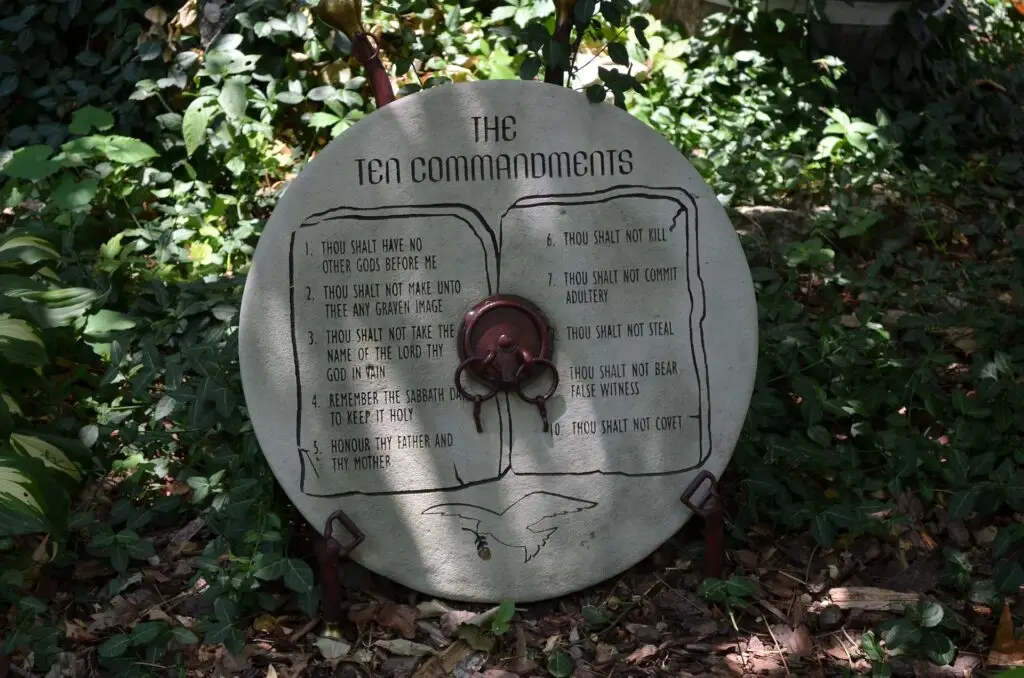
Moses descends the mountain carrying two tablets. He has been in conversation with the God who gave the instructions. He has, at some cost to himself, interceded for the people already — the text records that God described the consequences, and Moses negotiated. He comes down carrying the record of the covenant, and he comes down to a community that has honored the covenant’s name while dismantling its architecture.
The tablets break. Not because Moses is merely angry. Because the covenant cannot be handed to a community that is simultaneously performing it and contradicting it. The smashing of the tablets is not a tantrum. It is a legal act — one that Jewish and Christian commentary has long interpreted as symbolizing a covenant already violated before its formal ratification: you cannot ratify what has already been broken by the party receiving it.
What follows — the Levites’ response, the plague, the second tablets, Moses’ face shining when he returns — is the text’s answer to the question of whether the covenant survives its first communal failure. It does. But it survives at cost, and it survives not through the community’s faithfulness but through Moses’ intercession and through a mercy that, the text makes clear, was not owed.
Section V
What the Silence Produced, and What Survived It
I’ve been thinking about this for weeks — how much of what we call our own commitments is really just re-performing what our formative environments taught us was the appropriate response to collective anxiety. The calf is not the story of people who stopped believing. It is the story of people who believed the way they had always believed, using the forms they had always used, and called it faithfulness to something new.
The tabernacle’s portability was a theological proposition: presence that is not contingent on permanence. The people at the foot of the mountain had the blueprint. They did not yet have the building. And in the gap between the instructions and the structure, they filled the silence with gold.
This is the interval every institution negotiates, and most negotiate badly. The founding text arrives. The structure it was meant to generate has not yet been built. In the gap, those who received the text reach for whatever grammar is immediately available — usually the grammar of whatever formed them before the new instruction arrived. The impulse that produced the calf runs through the entirety of the biblical narrative: from the demand for a king in 1 Samuel 8, to the temple’s transformation into a talisman in Jeremiah 7, to the disciples’ question, in the shadow of the Ascension, about whether now was the time to restore the kingdom.
What the Sinai narrative preserves, across the failure, is the insistence that the covenant was not contingent on the community’s faithfulness to it. The tablets were remade. The tent was still assembled. The presence that the community tried to pin into gold moved, as it had always moved, with the people who could not quite manage to deserve it. They built the wrong thing in the right name — and the covenant survived even that.
The people filled the silence with gold.
They used the covenant name.
They proclaimed a feast.
They built the wrong thing in the right name.
The tablets were remade.
The tent was still assembled.
The presence moved.
— Watchman
1 Weber, Max. Economy and Society: An Outline of Interpretive Sociology. Trans. Guenther Roth and Claus Wittich. University of California Press, 1978. Weber’s concept of “Veralltäglichung des Charisma” (routinization of charisma) addresses the process by which the personal authority of a founding figure must be translated into stable civic structure before that figure’s withdrawal. The application here — to a community’s regression under leader absence — is the author’s structural extension of Weber’s argument, not a claim Weber himself made. See also: Eisenstadt, S.N., ed. Max Weber on Charisma and Institution Building. University of Chicago Press, 1968.
2 Josephus, Jewish Antiquities, Book III, §97–99. Josephus presents Aaron’s compliance as a form of crisis management under popular coercion. The Talmudic discussion in Sanhedrin 7a develops the theme further, treating Aaron’s decision as a case study in the limits of leadership under duress. Both readings share the interpretive move of mitigating Aaron’s culpability by emphasizing the social pressure he faced; the text of Exodus itself, characteristically, neither confirms nor forecloses this reading.
3 Wolin, Sheldon S. Democracy Incorporated: Managed Democracy and the Specter of Inverted Totalitarianism. Princeton University Press, 2008. Wolin’s analysis concerns modern representative democracies and is not a biblical study; the comparison drawn here is structural rather than historical, applied to the mechanism of hollowing out — the preservation of legitimizing form while the animating purpose is evacuated. On the Enabling Act of 1933, see Evans, Richard J. The Coming of the Third Reich. Penguin Press, 2004, Chapter 7.