Section I
The Speech Nobody Expected at the End of a War
I’ve been thinking about this for weeks — how much of what we call mercy is really just re-digging what someone before us started.
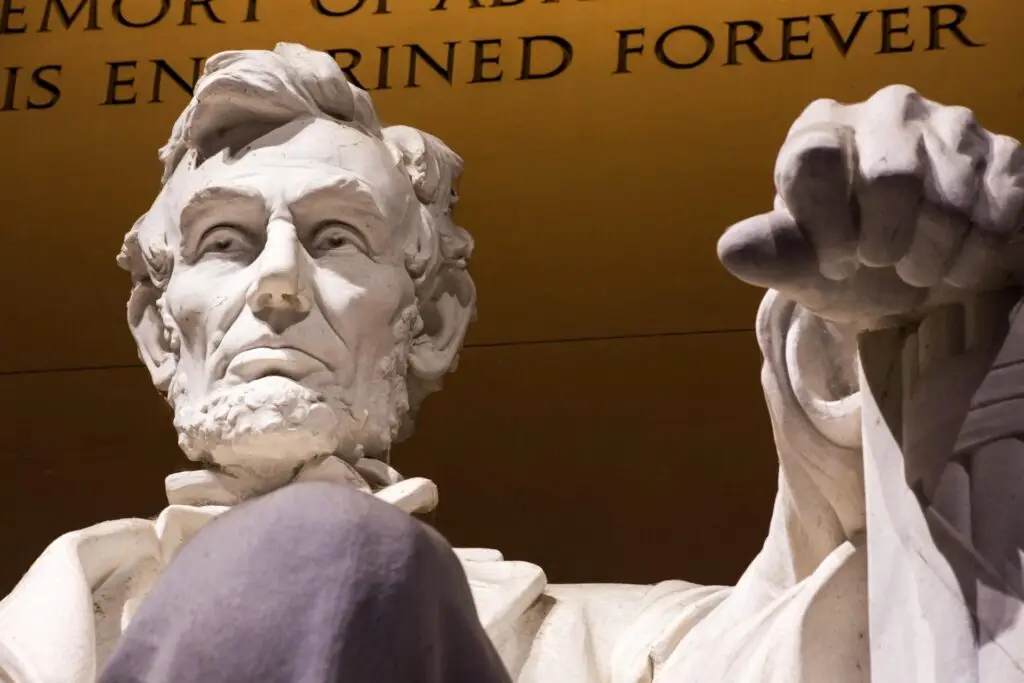
Lincoln delivered his second inaugural address on March 4, 1865. The outcome of the war was no longer in doubt. Grant had Lee pinned at Petersburg. Sherman had finished his march. Richmond would fall within a month. The dead had already been counted past six hundred thousand, and the men in the audience — soldiers, politicians, citizens who had lived inside four years of industrial-scale slaughter — had every historical reason to expect what victorious leaders typically deliver at the moment of triumph: a reckoning, a settlement of accounts, a language of justified retribution. The political class was prepared for it. The country had earned it, by any conventional measure of what wars cost and what victories entitle.
What they got instead was this:
“With malice toward none, with charity for all, with firmness in the right as God gives us to see the right, let us strive on to finish the work we are in, to bind up the nation’s wounds.”
— Abraham Lincoln, Second Inaugural Address, March 4, 1865
The speech is 703 words. It mentions God fourteen times. It quotes the Bible twice. It does not name a single Confederate general. It does not celebrate a single Union victory. What it does — and what made it so disorienting to its original audience — is refuse the grammar of victory altogether and propose, in its place, a grammar of reconstruction.
Lincoln was shot forty-one days later. The Reconstruction he envisioned did not survive him.
But the speech itself survives — a document that belongs less to political history than to the tradition of arguments made on behalf of people who had not yet earned the argument. That tradition, it turns out, is very old. It runs through a mountain in Sinai, through a shattered set of stone tablets, through the tent of the covenant, and through a negotiation that took place before Lincoln’s republic existed, before Rome existed, before any of the Western constitutional orders that produced the language Lincoln used had been assembled.
In the previous installment, we examined what the people built in the silence — the golden calf, the feast held in the covenant name, the liturgical grammar of Egypt reasserted at the foot of the mountain where the covenant had just been given. The Idol They Built While He Was Gone → This installment begins at the moment after the tablets break. Moses has seen what the community did. The tablets are dust. The calf is ground to powder and dissolved in water. Somewhere between three thousand dead and the silence that follows, Moses turns and goes back up the mountain.
He goes to negotiate.
Section II
What the Terms of Reconstruction Have Always Cost
The history of post-betrayal negotiation is not a history of clean outcomes. It is, more often, a history of what the negotiator absorbs so that the community does not have to.
Lincoln understood this in a way that few American presidents have. He had spent four years presiding over a war that the Confederacy had initiated, prosecuted at a cost in blood that had no precedent in American history. By the spring of 1865, the political logic of the moment was clear: the South had broken the compact, had fired on Fort Sumter, had established a rival government in explicit rejection of the constitutional order. The Radical Republicans, who controlled Congress, were prepared to treat the Confederate states as conquered territories requiring full federal reorganization before readmission. The word “malice” in Lincoln’s address was not rhetorical. It was a direct address to the punitive program that his own party had been developing for years.
Lincoln proposed something different — and in retrospect, his instinct appears strikingly consistent with lessons later illustrated by the catastrophic settlement at Versailles in 1919. The Versailles Treaty imposed reparations on Germany that the economist John Maynard Keynes, in The Economic Consequences of the Peace, argued would destabilize the European order within a generation.1 He was roughly correct. A defeated party bound by terms it considers permanently unjust tends to organize its next political generation around the injustice of the settlement rather than the consequences of its own decision. Lincoln’s instinct — whether derived from political calculation, theological formation, or both — was that the same dynamic threatened the postwar American compact.
The Reconstruction that followed Lincoln’s assassination proved far more fragmented and contested than he had imagined. The forces that dismantled it were multiple: Andrew Johnson’s systematic obstruction, organized Southern resistance that included the paramilitary violence of the Ku Klux Klan and the systematic terrorizing of Black voters and officeholders, the exhaustion of Northern political will after a decade of war and instability, the economic dislocations of the Panic of 1873, and a Supreme Court that progressively narrowed the reach of the Fourteenth Amendment through the 1870s and 1880s. What the historian Eric Foner describes as “America’s unfinished revolution” was undone not by a single decision but by the accumulated weight of institutional failure — and by the unwillingness of the nation, ultimately, to enforce the civic equality it had written into law at the cost of the war that preceded it.2 The freedmen who had briefly held elected office, acquired land, built schools, were returned, generation by generation, to a condition the law no longer called slavery but which the law also declined to fully prevent.
What Lincoln had argued for from the podium on March 4, 1865 remained, for nearly a century, a promissory note the nation was not yet prepared to honor. The Constitutional amendments he had envisioned as the legal architecture of a renewed union — the Thirteenth, Fourteenth, Fifteenth — were passed, then effectively suspended by the same legal culture that had ratified them.
The institutional lesson, if there is one, is sober: the negotiation after the betrayal is never fully resolved in the generation that conducts it. What the negotiator argues for is not an outcome but a framework — a set of conditions under which resolution, if it comes, becomes possible rather than foreclosed. History repeatedly suggests that such frameworks require individuals willing to bear costs others prefer to avoid. The political grammar of Lincoln’s moment was victory. Someone had to make the argument for the more expensive option.
Moses went up the mountain twice. He came down with broken tablets once, and with the second set — cut by his own hands this time — the second. The reconstruction he carried back was not the same as what had been given in the first descent. It was marked by what had happened in the interval.
Section III
What Moses Said When He Went Back Up
The text of Exodus 32:30 is quiet in the way that only very serious things are quiet.
“The next day Moses said to the people, ‘You have sinned a great sin. And now I will go up to the LORD; perhaps I can make atonement for your sin.'”
— Exodus 32:30 (ESV)
Perhaps. The word is not confidence. It is not certainty. It is the word of a mediator who knows the weight of what he is carrying and does not pretend to know the outcome. Moses goes up with the full knowledge of what has been done below and with no guarantee of what the negotiation will yield. He goes because there is no one else to go.
What he says when he arrives is one of the most remarkable sentences in the Hebrew Bible:
“But now, if you will forgive their sin — but if not, please blot me out of your book that you have written.”
— Exodus 32:32
The grammar of the sentence is deliberately incomplete in the original Hebrew. “If you will forgive their sin —” the sentence breaks off. The condition is stated. The consequence, if the condition is met, is left suspended — because Moses has no alternative to offer. He does not complete the bargain because there is no bargain to complete. He simply places himself in the position of the people he is interceding for and dares the judgment to include him.
This is intercession in its irreducible form: not petition, but substitution. Not “please forgive them” but “if you will not forgive them, then I am also not forgivable.” The mediator refuses to survive the outcome he is arguing against.
“The LORD replied to Moses, ‘Whoever has sinned against me I will blot out of my book. But now go, lead the people to the place I spoke of, and my angel will go before you.'”
— Exodus 33:17
The response neither accepts Moses’ offer nor dismisses it. It redirects — and in the redirection, the presence continues. The people are not abandoned. The destination remains. But the terms have shifted: the original unmediated covenant has become mediated through the angel. Something has changed. The relationship has survived the betrayal, but it has survived it at the cost of a reconfiguration neither party had sought.
Exodus 34 gives the reconstruction its visible form: Moses cuts two new tablets from stone — the first set had been made by God entirely; these are cut by Moses himself — and the LORD writes the words again. The proclamation that follows is the theological center of the whole episode:
“The LORD, the LORD, a God merciful and gracious, slow to anger, and abounding in steadfast love and faithfulness, keeping steadfast love for thousands, forgiving iniquity and transgression and sin, but who will by no means clear the guilty.”
— Exodus 34:6–7
The proclamation holds two things that should be mutually exclusive — “forgiving iniquity” and “by no means clearing the guilty” — in permanent and unresolved tension. The covenant that resumes is not the covenant of forty days ago. It is a covenant that has been renegotiated through grief, through anger, through three thousand dead, through a broken set of tablets, and through an argument made on a mountain by a man who offered himself as forfeit for a community that had not yet stopped sinning.
The second tablets descend. Moses’ face shines. He has been in sustained, costly proximity to something he could not control, and the proximity has left its mark.
Section IV
The Cost the Negotiator Absorbs
The pattern that Exodus 32–34 identifies is not primarily about divine forgiveness. It is about the structural role of the mediator in post-betrayal reconstruction — and what that role costs the person who occupies it.
The comparative record on post-conflict settlements offers a consistent finding: frameworks built primarily on the logic of punishment tend to produce durable resentment rather than durable reconstruction. History offers surprisingly few examples of victorious powers choosing reconstruction over humiliation — and the contrast between those that did and those that did not is instructive. The Versailles settlement of 1919 illustrated the cost of the more common choice at continental scale. The Marshall Plan of 1948 represented the institutional learning from that failure — the United States invested approximately $13.3 billion in the reconstruction of economies it had just defeated and allies it had just rescued, with no reparations demanded.3 These are European cases, distant from the Sinai narrative and from Lincoln’s. But they share the same structural logic: the negotiator who absorbs the cost of generosity at the moment of maximum political temptation to punish is the one whose framework, however imperfectly, survives. Lincoln understood this before the European century had made it legible. Moses argued it before Lincoln’s republic existed.
But the more instructive case for the Exodus pattern is not the Marshall Plan. It is Lincoln — because Lincoln’s situation most closely replicates the structural position Moses occupied. Both were mediators who made the argument for reconstruction at the precise moment when the communities they served had the most political justification for punishment. Both absorbed, personally, the cost of that argument. Lincoln in his willingness to alienate the Radical Republicans who controlled his Congress. Moses in his willingness to offer himself as forfeit in a negotiation whose outcome he could not guarantee.
The sentence Moses uses — “perhaps I can make atonement for your sin” — is the sentence of every institutional leader who has ever stood between a community and the consequences of what the community did, knowing that the outcome is not in their hands, and going up anyway. The word “perhaps” is not weakness. It is the honest vocabulary of someone who understands that intercession is not a guaranteed transaction. It is a presence offered in the gap, without certainty of return.
What returns from the mountain is marked. Moses’ face shines. No one can look at him directly. He has to veil himself. The shining is not triumph — it is the residue of proximity to the renegotiated covenant, and it is not entirely comfortable to those who receive it.
Lincoln’s equivalent of the shining face is the second inaugural itself — a speech so theologically saturated, so far outside the expected register of a wartime president, that his contemporaries were not quite sure what to make of it. Frederick Douglass, who heard it delivered, called it “a sacred effort”; the Chicago Tribune, which had supported Lincoln throughout the war, found it insufficiently celebratory. Both responses registered the same thing: here was a man who had come back from somewhere carrying something they did not yet fully recognize.
Section V
The Second Set of Tablets Was Always Going to Be Different
There is a question the text raises quietly in the detail Exodus 34 preserves, worth sitting with before the argument closes. Why did the second set of tablets need to be different at all? If the words were the same — and they were — why could not God simply remake what had been broken?
The answer the narrative implies is that reconstruction after betrayal is not a restoration. It is a continuation under altered conditions. The covenant could be renewed, but it could not pretend the interval had not occurred. The stone Moses cut was the covenant’s acknowledgment that it was now operating in a different moral environment — not a lesser one, but a more fully known one. The tablets had to reflect that, even if only in the hands that shaped them.
This is what makes the Reconstruction amendments structurally interesting — and structurally painful. The Thirteenth Amendment, which abolished slavery, Lincoln had pushed through Congress himself in January 1865, two months before the second inaugural. That much belonged to his vision. What came after his death was something harder. The Fourteenth and Fifteenth Amendments, along with the Reconstruction Acts of 1867, were shaped in a political environment increasingly defined by leaders who did not fully share Lincoln’s vision of reconciliation. They were encoding coercion — legal conditions imposed on states that had forfeited their standing by rebellion, ratification under military occupation, civic rights guaranteed not because the nation had become the thing the Declaration described but because the army was still present to enforce the guarantee. The second tablets were not beautiful. They were necessary. They bore the marks of what the first covenant had failed to say clearly enough — the marks of a nation that had to be legally instructed to treat its own people as people.
Martin Luther King Jr. would name what had happened a century later in terms borrowed directly from this structure: a promissory note, written in the language of the founding covenant, returned marked insufficient funds. The argument Moses made on the mountain, the argument Lincoln made at the podium — neither resolved in the generation that made it. Both accumulated. Both waited.
The stone was different.
The second tablets were not beautiful.
They were necessary.
Lincoln spoke of malice toward none.
The amendments that followed were written under military occupation.
Both belonged to the difficult work of covenantal reconstruction.
Neither was what anyone had originally intended.
Arguments made at the right moment accumulate.
They wait.
— Watchman
1 Keynes, John Maynard. The Economic Consequences of the Peace. Harcourt, Brace and Howe, 1920. Keynes resigned from the British delegation at Versailles in protest. The core argument appears in Chapter 5 (“Reparation”), where he contended that the reparations burden imposed on Germany was economically unsustainable and that the resulting instability would destabilize the European order within a generation. His prediction proved, in broad outline, accurate, though historians debate the degree to which Versailles directly caused the rise of National Socialism versus other interwar factors.
2 Foner, Eric. Reconstruction: America’s Unfinished Revolution, 1863–1877. Harper & Row, 1988. Foner’s characterization of Reconstruction as an “unfinished revolution” refers to the gap between the legal architecture of the Thirteenth, Fourteenth, and Fifteenth Amendments and the sustained failure of American political institutions to enforce them. On the organized paramilitary violence of the Ku Klux Klan and its role in suppressing Black political participation, see Chapter 9 (“The KKK and the Failure of Reconstruction”). On the Panic of 1873 and its political consequences for Northern will, see also White, Richard. The Republic for Which It Stands: The United States During Reconstruction and the Gilded Age. Oxford University Press, 2017.
3 U.S. Department of State, Office of the Historian. “The Marshall Plan, 1948.” history.state.gov. For modern dollar equivalency and program scope, see Congressional Research Service, The Marshall Plan: Design, Accomplishments, and Significance (January 2018). On the relationship between Versailles, the interwar period, and the Marshall Plan’s design logic, see Steil, Benn. The Marshall Plan: Dawn of the Cold War. Simon & Schuster, 2018.
4 Douglass, Frederick, quoted in Foner, Eric. The Fiery Trial: Abraham Lincoln and American Slavery. W. W. Norton, 2010, p. 315. Douglass attended the second inaugural and described it as “a sacred effort” in a letter to Lincoln written shortly after the address. The Chicago Tribune response is documented in White, Ronald C. Lincoln’s Greatest Speech: The Second Inaugural. Simon & Schuster, 2002.
5 All scripture quotations are from the English Standard Version (ESV). The Holy Bible, English Standard Version. Crossway Bibles, 2001.