Hook
Two Signatures at the End of the War
Some silences begin with a signature.
When the American prisoners freed from Berga, a slave-labor subcamp of Buchenwald, were being sent home in 1945, the Army had them sign a pledge not to speak about what had happened there (United States Holocaust Memorial Museum [USHMM], n.d.).[1] According to CNN’s reporting, the Army’s own form warned them against giving any account of their experience in books, newspapers, broadcasts, or lectures (Drash, Gutierrez, & Weisfeldt, 2008).[2] One of the men who signed was a twenty-year-old medic from San Bernardino, California, named Anthony Acevedo.
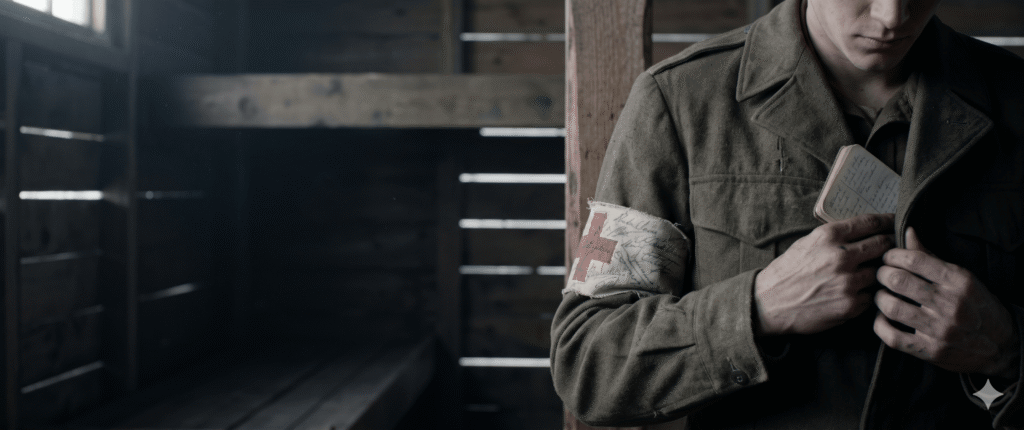
He had gathered signatures of his own. After liberation on April 23, 1945, he asked fellow prisoners to sign the cloth Red Cross armband he had worn through captivity (USHMM, n.d.). The first paper asked for silence. The second, scrawled by survivors, said that they had been there.
He also kept a notebook in which he had written, one by one, the men who did not live to sign anything. Asked years later why he had risked it, he answered, in a museum staff member’s recollection, “It was my moral obligation to do so” (Schuster, quoted in Woolf, 2018).[3] I wanted to know what he owed the men in that notebook once the war had ended and the Army asked for his silence.
Historical Case
From a Draft Notice to a Boxcar
Acevedo was born in San Bernardino in 1924 to Mexican parents. In 1937 the family moved to Durango, Mexico.[4] He was an American citizen by birth, and he returned to the United States to join the Army (USHMM, n.d.).
He trained as a combat medic and reached France in December 1944. After about ten days at the front, his company was surrounded and surrendered on January 6, 1945 (Woolf, 2018; USHMM, n.d.). At Stalag IX-B in Bad Orb, by his later account, a German commander ordered Jewish American soldiers to step forward.
Too few did, and others were pulled from the line (Woolf, 2018). Many of the 350 men sent to Berga were chosen because they were Jewish or because their captors thought they were (Daily Record, 2009).[5] Acevedo, a Catholic, was among them.
At Berga the prisoners worked twelve-hour shifts digging tunnels and working in mines, and Acevedo was one of six medics among them (USHMM, n.d.; National WWII Museum, 2020).[6] A notebook had come to him in a Red Cross parcel, and in it he wrote each dead man’s name, the date, and the cause (USHMM, n.d.). He hid it on his body and, according to the Army’s museum, stretched his ink with snow and urine (National Museum of the United States Army, n.d.). He remembered the list growing “little by little” (National WWII Museum, 2020).
In early April 1945, with Allied armies closing in, the guards marched the prisoners out of Berga. Acevedo pushed the cart that carried the men who could no longer walk (USHMM, n.d.). After more than two weeks on the road, most of the guards fled and American tanks arrived, and Acevedo, by his own recollection, weighed eighty-seven pounds (Woolf, 2018).
The notebook was one man’s field record, not an official finding. Even so, museum staff describe it as one of the main sources for what the Army later learned about the men’s fates (Woolf, 2018). The historian Flint Whitlock calls Berga the only known instance of captured American soldiers being turned into slave laborers at a Nazi concentration camp (Whitlock, 2009).[7] Records kept by individuals can preserve what official records never captured.
Biblical Lens
Three Verses About Names That Are Carried
Three passages sit near this story. None was written about a prison camp, and each fits only in part. For each I will say what the text says, then what I am borrowing from it.
And Aaron shall bear their names before the LORD upon his two shoulders for a memorial.
Exodus 28:12 (KJV)[8]
The high priest’s garment carried two engraved stones, six tribal names on each (Exodus 28:9–10), and the text calls them a memorial. It says that a representative bears a people’s names before God. I borrow only the posture: someone carrying names on behalf of others. Acevedo held no priestly office, and his notebook was a private act, not a rite.
Behold, I have graven thee upon the palms of my hands; thy walls are continually before me.
Isaiah 49:16 (KJV)
In this chapter the people have said they are forgotten (Isaiah 49:14), and the answer is that even a mother might forget her nursing child while God will not (Isaiah 49:15). The verse is a promise about God’s memory, not a comment on notebooks. What I borrow is narrower: a person’s standing does not depend on how complete any human record turns out to be. That is a comfort, and it is not a reason to stop keeping records.
Also now, behold, my witness is in heaven, and my record is on high.
Job 16:19 (KJV)
Job is quarreling with friends who have already judged his suffering, and he appeals to a witness above them. He is defending his own case, while Acevedo wrote down other men’s deaths. The borrowed point is small: a record can be worth keeping even when the people nearest cannot or will not hear it.
Read in sequence, the three give the story an order: names are carried, names are held, and a record is kept when no one is listening. The notebook touches each of these only by analogy, and the analogy should not be pressed further than that.
None of this obliges us to read any ordeal as a sentence handed down from above. The application that follows is mine, not the texts’: a nation’s habits over time show what it was prepared to live with, including what it writes down and what it asks its survivors to leave unsaid.
Pattern Insight
The List That Could Not Be Finished
The three objects are not the same kind of thing. The pledge was demanded of him, the armband was signed by others, and the notebook was his own. What they share is one question: after a war, who is responsible for recording the dead, and who for hearing the survivors?
About 350 American prisoners were sent to Berga, and the museum says only about half came home (Woolf, 2018).[9] Acevedo’s list names many of the dead but not all, because the men died faster than he could write (USHMM, n.d.). A list kept by a prisoner under guard cannot be complete, and nothing in the sources suggests he believed it was.
An incomplete record is not a failed one, because the duty was to carry the names, not to finish the list.
The pledge dates to 1945. By the museum’s account, Acevedo began speaking about Berga to local groups in 1999, fifty-four years after liberation, and later to national newspapers (USHMM, n.d.). After CNN profiled him in November 2008, Representatives Joe Baca and Spencer Bachus pressed the Army secretary to act, and the Army reviewed the camp for months (CNN, 2009).[10]
In June 2009, at a gathering of survivors in Orlando, Maj. Gen. Vincent Boles told them Berga had been a slave labor camp, not a prison camp, which by CNN’s account no ranking Army official had said before (CNN, 2009). Acevedo did not attend, feeling the ceremony belonged in Washington (CNN, 2018).[11] The paperwork ran on a longer clock: sixty-four years.
The Army Center of Military History has said the secrecy was meant to protect escape-and-evasion methods and the identities of people who had helped escaped prisoners (HistoryNet, 2009),[12] and that reasoning deserves its place in the record. Why the restriction stood so long after the war is a question these sources do not answer.
An earlier essay here asked who keeps a name once everyone who knew it is gone (The Stone Under the Lilac). Here the people who knew the names were alive and had been asked to keep quiet.
When Acevedo went home, his father, by the museum’s account, called him a coward for having been captured (USHMM, n.d.). In later years Acevedo spoke at schools and colleges, and the counsel he left students was to answer hatred with more love and more respect (Woolf, 2018).
A record is only half of remembering. The other half is someone willing to read it.
Closing
The Names Outlasted the Pledge
In the previous installment, a restaurant worker could still point to the first table she had cleared (The First Table). Acevedo had a notebook.
The pledge asked for silence, and he began to speak in 1999. The armband carries the names of men who survived, and the notebook carries the names of those who did not. The armband, the Catholic prayer book he carried, and the notebook are now in the museum’s collection, where the notebook can still be read as he wrote it: name, date, and cause of death, in the order the men died.[13]
- United States Holocaust Memorial Museum, Anthony Acevedo Collection: armband (irn42602), prayer book (irn42603), diary and papers (irn42600), collections.ushmm.org, gift of Anthony Acevedo, 2010. ↩
- Wayne Drash, Thelma Gutierrez, and Sara Weisfeldt, “WW II vet held in Nazi slave camp breaks silence: ‘Let it be known,’” CNN.com, November 11, 2008 (excerpt via History News Network). ↩
- Christopher Woolf, “This POW kept a secret diary that showed daily life in a concentration camp,” The World (PRX), March 27, 2018. ↩
- Woolf (2018) describes a deportation. Other biographical accounts say the father moved the family after the stepmother was deported. Sources agree on the 1937 move to Durango, not on the mechanism. ↩
- Daily Record, “Ex-POWs battle memory of labor camp,” 2009 (excerpt via History News Network). ↩
- National WWII Museum, “Anthony Acevedo: Mexican American POW Survivor,” October 9, 2020; National Museum of the United States Army, “Anthony C. Acevedo,” biography (ink detail). ↩
- Flint Whitlock, Given Up for Dead: American GIs in the Nazi Concentration Camp at Berga (Basic Books, 2009), as described in the publisher’s catalog entry. ↩
- Scripture quotations are from the King James Version (public domain). ↩
- USHMM gives “about half” for the 350 sent to Berga. Counts of deaths vary by source and by whether the death march is included, so no single figure is used here. ↩
- CNN, “WWII slave soldiers reunite after 64 years, prepare for honors,” June 3, 2009; CNN, “Slave soldiers honored, called ‘national treasures,’” June 2009 (excerpts via History News Network). ↩
- CNN, “Medic who documented Nazi camp horror dies at 93,” March 9, 2018 (via WTKR). ↩
- HistoryNet, summary of CNN’s 2009 reporting on the Army Center of Military History’s explanation. ↩
- CNN.com, “‘You don’t forget’: Medic’s Holocaust diary tells story of hell” (excerpt via History News Network, n.d.), which reproduces entries by surname and date; USHMM, Anthony Acevedo papers (irn42600), which describes the diary as recording each man’s name, date, and cause of death. ↩
New essays every week. Delivered quietly.