Hook
Grief keeps its appointments by the clock, and so does negligence.
At 9:15 on the morning of October 21, Wales was invited to pause. The First Minister had asked schools, offices and workshops across the country to observe a minute’s silence, sixty years to the minute after a coal tip above the village of Aberfan slid down Mynydd Merthyr onto Pantglas Junior School and the houses beside it (Welsh Government, 2026). One hundred and forty-four people died that morning. One hundred and sixteen of them were children.
I keep returning to one detail that never makes it into the headlines. It is the hour. A quarter past nine was a school day only just underway, and across six decades it has become the single fact a whole country agrees to hold still.
The tip that collapsed, known as Tip 7, had been started in 1958 on ground where natural springs emerged. The tribunal that sat for seventy-six days concluded in 1967 that the disaster could and should have been prevented, and that blame rested on the National Coal Board (Tribunal Report, 1967). Earlier this week, the Prime Minister stood in the memorial garden and said he did not think Aberfan had been treated properly by the authorities (ITV News, 2026).
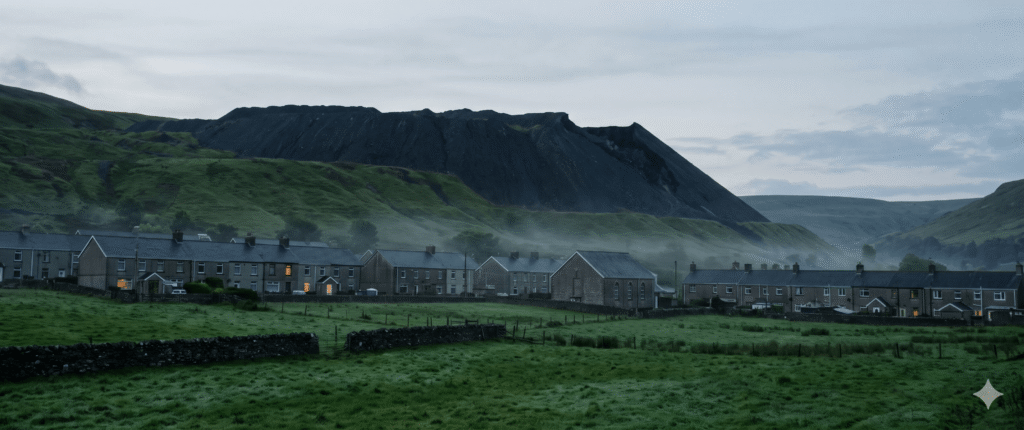
Twenty-five years before that morning, a Hollywood studio built a Welsh mining valley and let its audience watch a hill rise above it. The film was no warning, and nothing in it foresaw Aberfan. It was a portrait of what a prosperous industry leaves on the land it feeds from, and of the particular green a memory paints over it. Watched now, it asks the question the anniversary asks too: what does a community lose when the work that sustains it begins to reshape the ground beneath it?
Historical Case
A valley can be rebuilt perfectly and still be remembered selectively.
How Green Was My Valley (1941) rests on Richard Llewellyn’s 1939 novel, which is told as one man’s recollection of a world already gone (Llewellyn, 1939). The novel remembers in words. John Ford’s film remembers in black-and-white images and a narrator’s voice, and Ford built the village in California’s Santa Monica Mountains from timber and plaster, a Welsh valley that American audiences were invited to love from a safe distance. The film won Best Picture over Citizen Kane and gave Ford his third directing Oscar, one year after the Joads’ road west, which we followed in the previous installment.
Some stories don’t need me to explain why they matter. They need to be retold plainly. The Morgan family lives in a mining village, and father and sons alike go down into the same pit. When wages are cut, the sons come to believe that the men must stand together. The father, a proud and upright man, holds to a different loyalty: to the order that has fed his household and to his own sense of how a man conducts himself. Neither side is a villain, because one is protecting what keeps the table full and the other is claiming dignity. The family that ate together divides exactly along that line.
The sons leave, and one is killed underground. Years later the father dies in the dark while trying to reach a trapped man. Throughout, the camera keeps returning to the slag heap. It never arrives in a single scene. It advances a little each season across the valley floor, until the green survives mainly in the narrator’s voice.
Biblical Lens
Genesis keeps a household’s wound and its reckoning in the same story.
Joseph’s story opens with unequal love. We have looked before at what happens when we measure our lives against the people beside us, and Genesis shows that instinct at its most dangerous, hardened inside one family. Jacob’s preference for one son turns the others against him.
Genesis 37:4, paraphrase: Seeing that their father loved Joseph above them all, his brothers hated him and could not speak peaceably to him.
When the brothers sell Joseph, the loss falls on the old man. The text records that his children, the very ones whose act caused the grief, came to comfort him, and that he refused. It does not explain what moved them, and we should not supply a motive the text withholds.
Genesis 37:35, paraphrase: All his sons and daughters tried to comfort him, but he refused, saying he would go down to the grave mourning.
Years later Joseph speaks, and the way he speaks matters.
Genesis 50:20, paraphrase: You intended harm against me, but God intended it for good, to preserve many lives.
Joseph does not rewrite his brothers’ intent as kindness. He names what was meant, he names what was preserved, and he lets both sentences stand.
Scripture does not ask us to read every flood, strike or collapse as a verdict from heaven; it does insist that people, over time, reveal the moral terms on which they chose to live.
One limit deserves saying plainly. Joseph’s story concerns kin who wronged one another, and the right to forgive belongs to the wronged. It cannot be borrowed by an institution that would like to be forgiven, and it cannot stand in for an inspection that was never made. When a company or an agency reaches for the language of providence to describe what a ledger could explain, the old text is being used against its own grain.
Pattern Insight
The cost of an industry’s bargain falls on those who did not strike it.
The pattern is easier to see taken in order. An industry sustained a whole community’s living. That industry produced waste. The disposal of that waste was the responsibility of a specific organization. And when the danger became real, the people who bore its consequences were not the people who had made the decisions.
At Aberfan, each link is on the record. Tip 7 was not an accident of geography. It was added to, load after load, from 1958 until the morning it moved, and about 150,000 tonnes of material came down the hill, according to press reports of the anniversary (Nation.Cymru/PA, 2026). The tribunal’s report, published on August 3, 1967, laid blame on the National Coal Board (Tribunal Report, 1967), and the story told afterward is a documented chain of responsibility, one the word “accumulation” should never be allowed to blur.
What the report could not do was settle the matter the way the families hoped. Reporting on the fiftieth anniversary notes that nine senior staff were named, that none was demoted, dismissed or prosecuted, and that the chairman, Lord Robens, who had first pointed to hidden springs, conceded fault and remained in his post (Frost, 2016; see also McLean & Johnes, 2000). The same account records that money from the public fund for the bereaved was used to remove other dangerous tips, and was not returned until 1997. The truth was written down. Whether that was the same as accountability is a question the families are better placed to answer than I am.
America keeps a ledger of its own. In February 1972, a dam of coal waste gave way above Buffalo Creek hollow in West Virginia and killed 125 people. The company’s first public explanation invoked an act of God, and a commission appointed by the state later called it an act of man (Stern, 1976). The vocabulary changes between the two countries, and the structure does not.
Genesis and the film circle a related question, though from different directions: what happens to a family when the source of its security becomes inseparable from the source of its division? Jacob’s sons are divided by a father’s favor, the Morgan sons by wages and conviction. These are not the same tragedy, and neither stands in for a disaster that was an institutional failure and not a family quarrel.
What the film offers is the slow landscape: a green place darkening by degrees while everyone inside it has a reason to look elsewhere. What Genesis offers is a grammar for the reckoning: name the harm, name what was kept, and hold both in view. A memory that stays green can be a gift, but only if it does not take the place of the ledger.
Closing
Memory comforts; a record keeps faith.
Huw’s valley stays green because he remembers it that way, and a family that keeps its memory alive is doing something older than nostalgia. But the green valley in the film is private memory. Aberfan’s memory is public: a report, a memorial garden, the testimony of survivors and bereaved parents, and a minute set at an exact hour. The first preserves a lost world. The second preserves what was done.
The Bible holds both. It keeps the brothers’ names, the price of silver, the torn coat and the old man’s refusal, and only then lets the word good enter the story.
Perhaps that is what a green valley is for. It gives us something to mourn with, so that we are not tempted to mourn instead of telling the truth.
- Welsh Government, announcement of the 60th anniversary remembrance and minute’s silence, September 21, 2026.
- Report of the Tribunal Appointed to Inquire into the Disaster at Aberfan on October 21st, 1966 (HMSO, 1967).
- ITV News, “Prime minister meets Aberfan survivors ahead of disaster’s anniversary,” October 19, 2026.
- Richard Llewellyn, How Green Was My Valley (Michael Joseph, 1939).
- Nation.Cymru (PA), “Royals join families and survivors to mark 60th anniversary of Aberfan disaster,” October 21, 2026.
- Peter Frost, “Buried alive by the National Coal Board,” Morning Star, 2016; Iain McLean and Martin Johnes, Aberfan: Government and Disasters (Welsh Academic Press, 2000).
- Gerald M. Stern, The Buffalo Creek Disaster (Random House, 1976).
New essays every week. Delivered quietly.