Hook
An empire can empty out long before it is overrun
On October 22, Al Jazeera asked whether another round of war with Iran was approaching. One analyst it quoted suggested that renewed strikes might fall on the things that let a country function: electricity networks, transportation systems, bridges, essential services.1
That list describes strength as plumbing — wires, spans, switchboards. It is a fair description of what a modern state protects, and no one who has lived through a blackout would call it superficial. Grids feed hospitals, move food, and keep armies supplied. But infrastructure alone has never guaranteed that people will go on holding a state together.
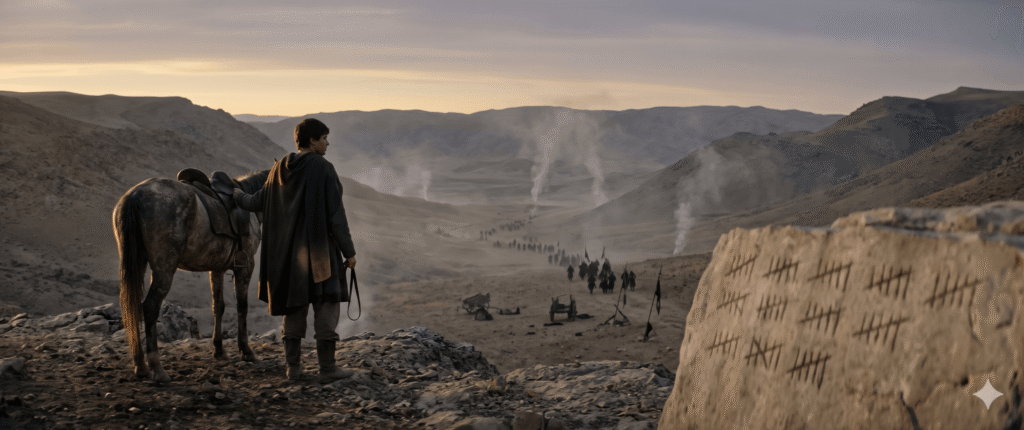
In 642, in a mountain valley near the town now called Nahavand, in Hamadan province, the last great army of the Sasanian Empire met the forces of the Rashidun Caliphate and was broken.2 “Last great” does not mean last resistance; the dynasty would survive, in fugitive form, for nine more years. The sources suggest that the defeat followed a long political fracture, and that it was the fracture, more than any shortage of soldiers, that left the army without a state behind it.
This essay makes no forecast about 2026, and it draws no line between the Sasanian Empire and the modern Iranian state, which are different things. It follows one young king through 642 and the nine years after it, and it ends with a calendar that is still being used.
Historical Case
Twenty-five years separate a siege and a mill
In the previous installment, we stood outside the walls of Constantinople in 626, where a Persian army sat across the strait while an Avar force pressed the city from the European side (the siege of Constantinople). That was the Sasanian Empire at the farthest edge of its ambition. A quarter century later, according to the tradition, its last king would die at a mill near Merv.
Between those two points lies a collapse in stages. Heraclius carried the war into Mesopotamia in 627, and in 628 the King of Kings, Khosrow II, was overthrown by his own nobles. Among the conspirators was a Persian aristocrat named Piruz, who later led one of the factions contending for the throne.3 Four years of rival claimants followed, in which the legitimacy of the crown and the interests of the great families pulled in different directions. In 632 the crown passed to Yazdegerd III, a boy commonly reckoned to have been about eight.3
The Arab armies arrived in this fractured house. Iraq was lost after Qadisiyya in 636. Jalula in 637 pushed Piruz back into Media, where he gathered the nobles who remained. Nahavand was the last large attempt to turn the tide.
Estimates put the Muslim force under Nu’man ibn Muqarrin at around 30,000. The chronicles give the Persian side several times that, a figure modern historians treat as literary rather than statistical.4 The battle is usually dated to 642, though the Islamic year 21 straddles 641 and 642. The fullest account comes from al-Tabari, who wrote in the late ninth and early tenth centuries and preserved earlier traditions rather than eyewitness reports. Some of those traditions describe a feigned Arab withdrawal that drew the Persians out of a strong position and into confined ground.5 Piruz died in the fighting, and so did Nu’man. Islamic tradition remembers the day as the “Victory of Victories.” A tradition recorded in later collections adds a quieter image: when the news reached Medina, the caliph Umar covered his face and wept for the fallen commander.6
Tabari also reports that many Persian nobles were already talking of dissolving the empire as the army gathered.5 Whether the young king watched from a distance or never left his refuge, the accounts disagree. They agree that he did not die there.
While writing this, I tried to find the single moment the empire ended. I couldn’t. Qadisiyya has a claim, Nahavand a stronger one, and the king’s death nine years later the most dramatic. None of them reads like an ending so much as another door closing in a house already emptying.
Biblical Lens
Daniel’s banquet and the king who ran
Daniel 5 holds the Bible’s most famous account of an empire’s night of reckoning. A Babylonian king feasts, a hand writes on the wall, and Daniel reads what it means:
“God hath numbered thy kingdom, and finished it. Thou art weighed in the balances, and art found wanting. Thy kingdom is divided, and given to the Medes and Persians.”
Daniel 5:26–28 (KJV)
What has always unsettled me about this chapter is its proportion. The interpretation takes three verses, and by verse thirty the kingdom is gone. The text treats the weighing as already finished before the writing appears; the wall only makes it legible.
The Medes and Persians named there are not the Sasanians, a later dynasty separated from Daniel’s world by centuries, so this is a resonance, not a lineage. The valley of Nahavand does lie within reach of Hamadan, the city that stands over ancient Ecbatana, the old Median capital. That is a geographical echo, not evidence of any link between the text and the battle.
The two kings differ, too. Belshazzar stayed at the table, where the fingers of a hand wrote against the lampstand on the plaster of the palace wall, and the text says the king watched it move (Daniel 5:5). Yazdegerd kept moving, district to district, for nine years, with no palace wall left to read. More than eleven centuries separate them, and the comparison concerns posture, not psychology.
Two other texts describe what fails to hold:
“There is no king saved by the multitude of an host: a mighty man is not delivered by much strength.”
Psalm 33:16 (KJV)
“The race is not to the swift, nor the battle to the strong…”
Ecclesiastes 9:11 (KJV)
Scripture does not ask us to treat every fallen city as a verdict handed down from above. Its quieter claim is that pressure can expose the moral terms a society has been living on, and that those terms were set long before the pressure arrived.
Pattern Insight
Armies can be counted; a kingdom has to be held
Set the dates side by side. The dynasty ran from 224 to 651, about 427 years. Six years separate Qadisiyya from Nahavand, and nine more separate Nahavand from the end. Twenty-five years passed between a Persian camp on the Bosporus and a king’s death at Merv.
The figure I trust least in this story is the largest one, the Persian numbers in the chronicles. Whatever the true count, the sources point to a different shortfall: not soldiers, but agreement.
Here the evidence and the interpretation should be kept apart. The evidence is modest: reports of nobles drifting away before the battle, of eastern provinces reluctant to rally to the crown, and of a governor at Merv, Mahoe, said to have turned against the king.7 The interpretation is mine: that the defeat followed a longer political fracture, and that a large army cannot do its work without a court willing to feed it, command it, and answer for it. One reading of the drifting nobles is not betrayal but arithmetic: when a throne can no longer promise a family its land or its safety, agreement lapses quietly. An army is only as durable as the agreement that sustains it.
Job gave the failure of that kind of support its most exact image: a seasonal stream that swells in winter and disappears in the heat (Job 6:15–17). A recent essay here followed the image through Job’s friends, whose comfort came with an if (The Brook That Fails in Summer). If the reports of drifting nobles are right, their support looks like that stream: present in the good season, gone in the dry one.
The tradition says a miller killed Yazdegerd for his purse, and other accounts implicate the governor. The sources do not settle it, and the tradition may preserve a motive better than a fact. His son Peroz eventually found refuge in China.8 Whatever happened at the mill, the last scene of a king who once commanded multitudes brings Psalm 33 to mind: no king is saved by the size of his host.
Closing
The calendar outlasted the throne
The Zoroastrian religious calendar, in its Yazdegerdi reckoning, counts its years from the reign of Yazdegerd III.8 Its survival is not a verdict on him, and it need not mean loyalty to a vanished throne. He lost the army, the capital, the provinces, and finally his life. Yet a community that outlived him went on dating its ordinary days by the year a boy was crowned.
An earlier essay here followed a medic who kept the names of the dead in a notebook after he had been asked to keep silent (The Armband and the Certificate). A record, it concluded, is only half of remembering; the other half is someone willing to read it. A calendar is a record read without anyone deciding to read it, every time a community asks what day it is.
The list in that October article names things that can be rebuilt. This calendar names something that was never stored in a grid.
The line that held at Nahavand was not drawn across the valley. It was drawn through time, in the way a people chose to count its years.
- Al Jazeera, “Iran reveals ‘offensive’ doctrine, US issues alert: Is war imminent?” (Oct. 22, 2026). ↩
- Parvaneh Pourshariati, Decline and Fall of the Sasanian Empire: The Sasanian-Parthian Confederacy and the Arab Conquest of Iran (I.B. Tauris, 2008). ↩
- Pourshariati (2008), on Piruz and the Parsig and Pahlav factions; Yazdegerd’s age at accession is commonly given as about eight. ↩
- Hugh Kennedy, The Great Arab Conquests (Weidenfeld & Nicolson, 2007), on the reliability of medieval troop figures. ↩
- al-Tabari, The History of al-Tabari, Vol. XIV: The Conquest of Iran, trans. G. Rex Smith (SUNY Press, 1994), on the Nahavand campaign. ↩
- al-Hakim, al-Mustadrak, no. 5360, a tradition also transmitted in Tabari. ↩
- A. Zarrinkub, “The Arab Conquest of Iran and Its Aftermath,” Cambridge History of Iran, Vol. 4 (Cambridge University Press, 1975); Pourshariati (2008), on Mahoe and the eastern provinces. ↩
- FEZANA, “Lesson 7: Yazdgerd III and the Fall of the Sassanid Empire.” ↩
New essays every week. Delivered quietly.