S1 · Hook
Authority Is Tested on the Day Its Owner Is Away
Who answers the door when the one who holds the keys is a thousand miles off?
Every household and congregation meets that morning sooner or later, and the person who answers is rarely the one the titles would predict.
In the previous installment, we examined the Battle of Salsu, where a Sui column’s order to press on outlived the strength of the men told to obey it. Fourteen years later, and half a continent west, another capital faced the opposite problem. In the last days of July 626, the people of Constantinople looked out from their walls at two armies, while the emperor who might have given the orders was fighting a war far to the east.
S2 · Historical Case
A City Held in Three Pairs of Hands
I went looking for the emperor in this story and kept finding other people instead.
That was not neglect. Heraclius had been campaigning against Persia since 622, an enemy that had already taken Jerusalem and Egypt (Kaegi, 2003).[1] Staying in the capital would have meant abandoning the war that was meant to save it. He left the city under a regency of three: his teenage son Heraclius Constantine, the patrician Bonus, who answered for the defense, and Sergius, patriarch since the year Heraclius took the throne.
There is a particular kind of silence that follows a handover: the interval after someone trusts you with a city and before anyone knows whether the trust was earned. Sergius had already put the Church behind the war. According to Theophanes, writing generations later, he lent church treasure to fund the 622 campaign (Mango & Scott, 1997).[2] The treasure belonged to the Church, not to him, which makes the loan an act of stewardship more than of sacrifice. Theophanes also reports that Heraclius, once the siege began, divided his army and sent part of it back toward the city.
The attackers had done their sums as well. The Avar khagan, ruling from the Danube, brought siege towers, covered rams, and Slavic allies in hollowed single-log boats. A Persian army under Shahrbaraz waited across the Bosphorus at Chalcedon, and the two camps are said to have coordinated by fire signals over the water. What they needed was a way to join, and the only road between them was the sea.
The assault opened in late July. By the account in the Chronicon Paschale, the khagan’s terms amounted to leaving the city with little more than the clothes on one’s back (Whitby & Whitby, 1989).[3] The citizens refused. For roughly ten days, towers and storming parties tested the Theodosian walls, and each time the line held. In the final days, the Slavic boats gathered in the Golden Horn were caught and destroyed, the Persians never crossed, and the Avars withdrew in early August.
No single cause explains this. The walls mattered, and so did a navy that held the strait, and so did two allies who never managed to meet. The people inside mattered too, and the sources care most about them, which is the difficulty. The poet George of Pisidia, one of our closest witnesses, wrote as both eyewitness and celebrant (Howard-Johnston, 1995).[4]
A source that wishes a city well cannot be the whole check on its own story. An earlier essay here followed a commander who tested a letter by questioning the man who carried it, and the weakness is the same: confirmation from the claimant’s own side tells you little. The outline of events is secure. The inner weather of the city is not.
S3 · Biblical Lens
The Letter Spread Open
When Assyria’s army stood outside Jerusalem, its field commander shouted over the wall, in the people’s own language, that their king was powerless and their God no different from the gods of fallen cities (2 Kings 18:26–35). Hezekiah did not answer the voice. He carried the letter into the temple and laid it open there (2 Kings 19:14).
The parallel is real, but it is not a match. A king holds one office and answers for it, and Hezekiah brought to God a danger his own authority could not solve. Sergius stood inside a regency, carrying a defense that others had to share. The two stories meet where human responsibility and human limit meet.
God is in the midst of her; she shall not be moved.
Psalm 46:5 (KJV)[5]
Read carelessly, this verse becomes a guarantee that a faithful city cannot fall. The psalm is about trust while the earth is shaking, not about exemption from the shaking. The lines around the verse describe mountains sliding into the sea and nations in uproar (Psalm 46:2–3, 6), and the confidence is spoken from inside that noise. The sermons preached after the siege reached for exactly this kind of Old Testament language, and whether the evidence earned it is a question each reader has to weigh.
The book of Esther keeps a different discipline: a king cannot sleep, a scroll is opened, and the narrator never says who arranged it (Esther 6:1). We followed that scene in an essay on the book of Esther. It lets the reader infer a hidden hand and stops short of promising one.
Except the LORD keep the city, the watchman waketh but in vain.
Psalm 127:1 (KJV)
Surviving a siege does not certify a city, and falling to one does not condemn it; Scripture does not read outcomes that way. It does keep noticing that pressure brings out the kind of common life a people had been choosing all along.
S4 · Pattern Insight
What the Walls Could Not Hold Alone
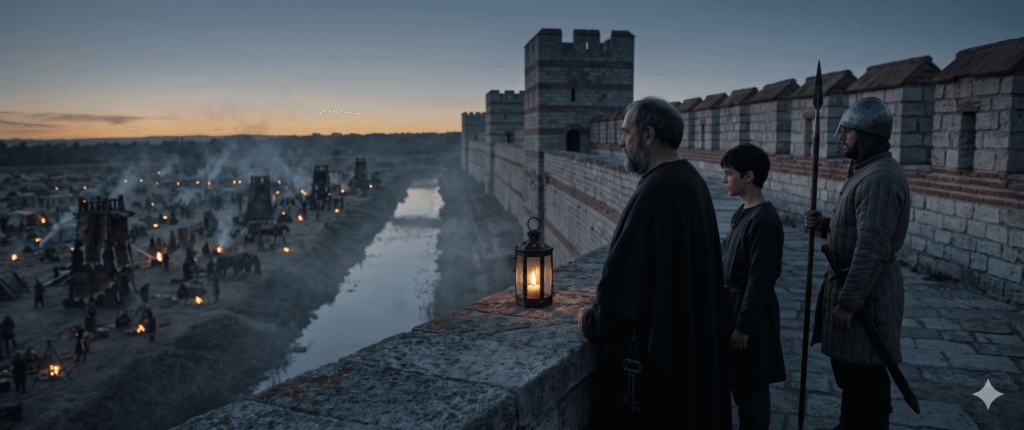
The figures are modest. The land walls ran a little over three and a half miles, a moat in front, then a low outer wall, then an inner wall of limestone courses banded with flat red brick that rose some forty feet, and had stood since the fifth century. A sentry on that parapet, looking west, would have had the khagan’s camp spread across the plain, and, looking back, the city he was holding for people he could not see. The siege lasted about ten days. The emperor and his field army were hundreds of miles away.
Those figures explain the geometry of the defense. They do not explain how a city without its emperor avoided breaking into a quarrel over who was in charge. What stands out in the sources is not a lone figure on the wall. It is that no one held every key: the soldiers answered to Bonus, the court to a teenager, the city’s prayers to a patriarch, and the empire’s strategy to a man hundreds of miles away. Authority and responsibility were scattered, and the city held, in part, because the pieces kept faith with one another.
That is where Psalm 127 turns from ornament to argument. It belongs to the songs of ascent (Psalms 120–134), the pilgrim songs sung on the road to Jerusalem, and it names the builder before the watchman and gives both the same verdict: the work is real, and the work is not the whole. The psalm does not dismiss the watchman. It dismisses the idea that the watchman is the last line. The watching is required, and it is never enough to guarantee the outcome.
The sources describe the patriarch walking the walls with sacred images, among them, in later tradition, an icon of the Virgin, and the liturgy folded the deliverance into the Akathist hymn. Tradition ties that hymn’s famous opening verse to 626, though the origins of the hymn as a whole remain debated. No historian can weigh what an image did to a single arrow. What a procession gives a frightened city is easier to describe: something to do together, in public, at the hour each person is most alone. The stewardship, the shared command, and the nerve of a crowd that stayed are things a historian can weigh.
An honest account cannot stop at admiration. Sergius is also remembered as the leading figure behind a formula about the will of Christ, later called Monothelitism, which was meant, on the usual modern reading, to draw the empire’s divided Christians together while its survival was in doubt. A church council condemned the position in 680–681, and Sergius with it by name (Price et al., 2014).[6] Scripture keeps the same honesty about Hezekiah, who after his deliverance showed Babylon’s envoys the whole of his treasury (2 Kings 20:12–19).
A brave night does not excuse a doctrine, and a doctrine does not erase a brave night. Both belong to the same man, and the record keeps both.
S5 · Closing
The Keys Belong to No One Alone
I began this essay meaning to admire Sergius, and I finish it unable to do that without keeping the ledger open.
The siege of 626 does not give us a tidy rule about prayer, or walls, or divine rescue. It shows a city in which the man with the title was far away and the people with the work were many. Nobody who answered the door that week held every key, and nobody who held a key was without fault.
Any household or congregation that has lost its head for a season knows the arithmetic: the work does not wait for the title to return. The watchman, in the end, is not the person who guards everything. He is the person who keeps his watch fully while knowing it is not the whole of the safety. That is a smaller claim than victory, and a more durable one.
A city, a church, or a house keeps what its people were willing to carry between them, and what they were honest about once the carrying was done.
[1] Walter E. Kaegi, Heraclius: Emperor of Byzantium (Cambridge University Press, 2003).
[2] Cyril Mango and Roger Scott, trans., The Chronicle of Theophanes Confessor (Oxford University Press, 1997).
[3] Michael Whitby and Mary Whitby, trans., Chronicon Paschale, 284–628 AD (Liverpool University Press, 1989).
[4] James Howard-Johnston, “The Siege of Constantinople in 626,” in Constantinople and Its Hinterland, ed. Cyril Mango and Gilbert Dagron (Variorum, 1995).
[5] Scripture quotations are from the King James Version.
[6] Richard Price, Phil Booth, and Catherine Cubitt, trans., The Acts of the Council of Constantinople of 680–81 (Liverpool University Press, 2014).
New essays every week. Delivered quietly.