Hook
Reaching a Thing Is Not the Same as Weighing It
On August 19, the National Oceanic and Atmospheric Administration published notice of an application from The Metals Company USA for an exploration license and a commercial recovery permit in the Clarion-Clipperton Zone, a stretch of Pacific seabed between Hawaii and Mexico. It was the first consolidated application of its kind (WorkBoat, 2026).1 NOAA found that it met the information requirements of the Deep Seabed Hard Mineral Resources Act, the threshold for review to proceed. It did not grant a license or a permit (NOAA, 2026).2
The area requested covers about 65,000 square kilometers, which a Pacific regional report on October 20 set at roughly a thousand times the size of Rarotonga, the main island of the Cook Islands (PINA, 2026).3 The sixty-day window for public comment closed on October 19. Certification, environmental review, and a final decision still lie ahead (NOAA, 2026).
This essay does not try to decide whether the mining should happen. It asks what would have to be known, and who would have to answer, for such a decision to be wise.
The book of Job contains a poem that frames that question with unusual precision: chapter 28, a portrait of miners that ends on a question the miners cannot answer. The previous installment followed what Job’s friends offered him and what each offer cost him (What Does the Bible Say About Job’s Miserable Comforters?). Here the text goes underground.
Historical Case
A Mountain of Silver Bought Armies and Did Not Buy Solvency
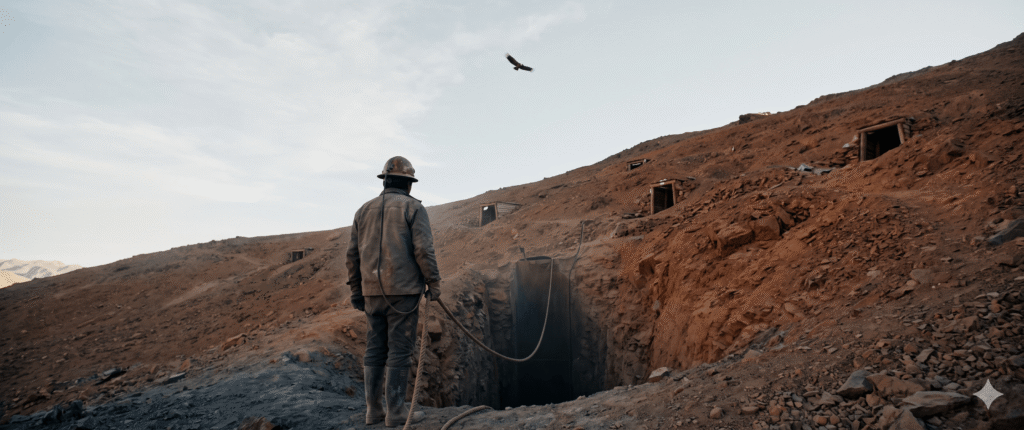
In 1545 the Spanish began working the silver of the Cerro Rico, the red hill above the Andean town of Potosí, in what is now Bolivia (Bakewell, 1984).4 Within a generation Potosí had become one of the largest cities in the world, with estimates for its early seventeenth-century peak near 150,000 people at an altitude above 13,000 feet (Lane, 2019).5 The Spanish idiom vale un Potosí, “worth a Potosí,” survives as shorthand for a fortune.
The labor came largely from the mita, a rotating draft of Indigenous men from the highland districts, which Viceroy Francisco de Toledo reorganized in the 1570s (Bakewell, 1984). The men drafted into the mountain worked underground for an output the rest of the empire counted in coin. Much of the silver moved through Seville into the accounts of the Habsburg monarchy, which spent it on armies in Flanders, the Mediterranean, and beyond. Philip II’s government still suspended payments to its creditors several times during his reign (Parker, 1998).6 The silver was real, and the spending outran it.
The Army of Flanders went unpaid often enough that it mutinied again and again between 1572 and 1607 (Parker, 1972).7 An essay here on the Battle of Salsu followed an army undone by what each man had to carry on his own back. At Potosí the burden ran from the other direction: silver arrived in enormous quantity, and the soldiers on its payroll still went without.
Potosí was a working mine inside an empire, while today’s application is still moving through review, and nothing here treats them as the same event. The comparison holds at one narrower point. When extraction becomes possible, the means arrive first, and the question of what the thing is for arrives later, and sometimes not at all. Job 28 puts that pattern into verse.
Biblical Lens
A Poem That Admires the Miner and Then Asks a Harder Question
“He putteth forth his hand upon the rock…” (Job 28:9, KJV)
Human skill, described with admiration.
“But where shall wisdom be found? and where is the place of understanding?” (Job 28:12, KJV)
The poem’s turn.
“…the fear of the Lord, that is wisdom…” (Job 28:28, KJV)
The poem’s answer, and its limit.
The poem opens with an inventory of what people can do. Silver has its vein and gold its refining place; iron is taken from the dust and copper is melted out of stone (28:1–2). The miner sets a limit to the darkness and searches to its farthest recess, cutting a shaft far from any settlement (28:3–4). The Hebrew of verse 4 is difficult, and some translators picture workers suspended on ropes.
The inventory keeps going. Fire turns the underside of the earth, sapphires lie in its stones, and the miner overturns mountains, cuts channels through rock, and brings the hidden thing into the light (28:5–11). Verse 7 holds the image the whole poem turns on: a path that no bird of prey has seen, which the lion has never walked. The miner reaches where the keenest eyes have not, and verse 12 asks whether reaching is the same as knowing.
The poem asks that question twice, at verses 12 and 20. The deep says wisdom is not in it, and the sea says it is not with it (28:14). It cannot be bought with gold, silver, onyx, sapphire, or coral (28:15–19). A poem that has just listed what machinery can unearth now lists what no machinery can buy. Only God knows the way to wisdom, and the poem gives humanity a practical word: reverence is wisdom, and turning from evil is understanding (28:28).
The poem never scolds the miner. Its admiration is audible, and the skill is real. What it declines is the assumption that the same hand can fetch both kinds of thing. Who speaks the poem is disputed. It sits inside Job’s long discourse yet reads like a pause in the argument, and scholars debate whether it belongs to Job, to a later hand, or to the narrator. The placement still matters. Job’s friends have spent chapters treating wisdom as a settled ledger of act and consequence, and Job has already answered, with some irony, that wisdom will die with them (12:2). Chapter 28 moves the question out of the debate and into the ground.
The text offers no warrant for treating every collapsed shaft or failed market as a verdict. What it leaves standing is smaller: whatever a society pursues with its best skill, and whichever costs it lets fall on others, becomes a record of the conditions it chose to live under.
Pattern Insight
The Machine Is Ready Before the Shared Rule Is
Two rulebooks are in play, and they do not move together. By NOAA’s own account, the International Seabed Authority regulates seabed mining beyond national jurisdiction for states party to the Law of the Sea Convention. The United States is not a party, and NOAA licenses American companies under a 1980 statute (NOAA, 2026).2 The Authority’s session ended on March 19, 2026, without agreement on a mining code, and more than 30 countries now call for a moratorium or a pause (Global Mining Review, 2026).8 In January NOAA finalized a rule letting an applicant seek an exploration license and a commercial recovery permit in one filing, and the company’s requested commercial area grew from about 25,000 square kilometers in an April 2025 application to about 65,000 in the consolidated one (NOAA, 2026; TMC, 2026).9
Three questions sit inside the disagreement, and they are easy to run together. Whether an application supplies the information the statute requires is a legal question, and NOAA has answered it. Whether scientists know enough about deep-sea species, microbial communities, and recovery times to authorize extraction is an empirical one. The company has described fifteen years of work as sufficient to move into commercial operations under NOAA’s oversight (TMC, 2026), while statements cited in the Pacific report called the science inadequate (PINA, 2026). Whose consent a decision about the common ocean requires is a third question, and neither paperwork nor science can answer it. The Pacific report puts it in those terms, warning that a domestic permit could have far-reaching consequences for international ocean governance and for Pacific states (PINA, 2026).
The sequence is visible regardless of which answer one prefers. The method matured, a domestic route to authorization was built, and the shared rule remained unfinished. It is the poem’s sequence, and Potosí’s: people reach what they can reach, the reaching earns admiration, and then it raises a question it cannot answer.
Gustavo Gutiérrez wrote from Lima, the viceregal capital whose port once sent much of the Andean silver toward Spain. He read the whole book of Job as a movement between two ways of speaking about God. One is the language of prophecy, which insists on justice for the innocent sufferer. The other is the language of contemplation, which receives God’s love as a gift that cannot be earned (Gutiérrez, 1987).10 I read chapter 28 as a pause between them, though Gutiérrez need not be pressed into saying so. Justice asks what we are doing and to whom; contemplation admits that some of what matters is not ours to extract.
Most readers meet this question at a smaller scale: a project delivered flawlessly and never questioned, a target met on schedule whose costs landed on people outside the room. Competence can be complete and still leave the central thing unlocated. The plan in Ten Dimes, where a Mississippi washerwoman divided her savings on a banker’s desk, ran in the opposite order. By the accounts there, Oseola McCarty arrived with the beneficiaries already named, and only then did the arithmetic begin.
Closing
The Deepest Shaft Does Not Reach It
The application that opened this essay is an excellent map. It measures the seabed in square kilometers and records what the machines can do there. Chapter 28 gives the earth the same attention, at length and with evident awe, and in verse 12 it lays the measure down.
The poem’s last instruction is plain enough to pass over: turn from evil. Before that, it says only God knows the way to wisdom (28:23–27). Wisdom is not a deposit to be located; the poem gives it to people only as a way of living. A miner on a rope, a regulator reading comment letters, a reader at the end of a working day could each practice it. None of them could haul it up.
On the Pacific floor the nodules lie where they have lain. The path no vulture has seen is not on the survey map either.
- WorkBoat, “NOAA opens public comment on first deep seabed mining recovery application,” 2026. workboat.com
- NOAA, Deep Seabed Hard Minerals Mining program page (applications list; Jan. 21, 2026 final rule), oceanservice.noaa.gov; Federal Register, Aug. 19, 2026, “Deep Seabed Mining: Notice of Receipt of Consolidated Application for Deep Seabed Mining Exploration License and Commercial Recovery Permit and Announcement of Public Comment Period and Virtual Public Hearing,” federalregister.gov.
- Pacific Islands News Association, “U.S. seabed mining bid raises concerns for Cook Islands,” Oct. 20, 2026. pina.com.fj
- Peter Bakewell, Miners of the Red Mountain: Indian Labor in Potosí, 1545–1650 (University of New Mexico Press, 1984).
- Kris Lane, Potosí: The Silver City That Changed the World (University of California Press, 2019).
- Geoffrey Parker, The Grand Strategy of Philip II (Yale University Press, 1998).
- Geoffrey Parker, The Army of Flanders and the Spanish Road, 1567–1659 (Cambridge University Press, 1972).
- Global Mining Review, “Why 2026 will decide who governs the seabed,” Apr. 22, 2026. globalminingreview.com
- NOAA program page above; The Metals Company, press releases and SEC filing on the consolidated application (2026).
- Gustavo Gutiérrez, On Job: God-Talk and the Suffering of the Innocent (Orbis Books, 1987).
New essays every week. Delivered quietly.