Hook
An Explanation Arrived Before the Fear Left
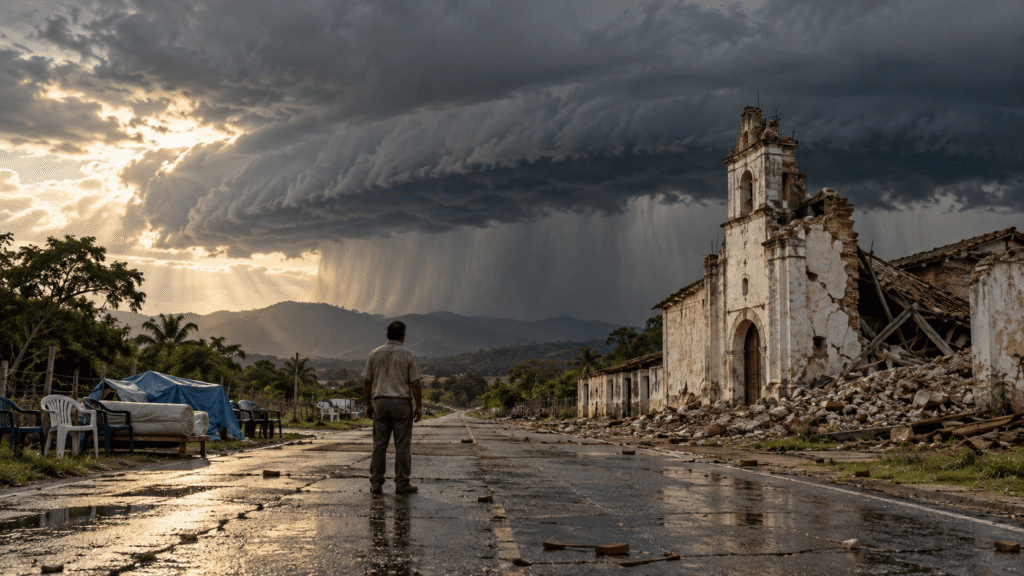
At 12:56 p.m. on October 9, a magnitude 7.7 earthquake ruptured beneath the Azuero Peninsula in southern Panama, shallow enough that the capital felt it for close to a minute (AFP, 2026).1 Part of the cathedral in Penonomé gave way. In La Villa de Los Santos, homes and a historic Catholic church collapsed (AP, 2026).2 The last quake to damage the country so widely had come in 1991.
No deaths had been reported as of October 13, a fact that sits strangely beside the photographs. At least 27 people were injured, and more than 300 aftershocks had followed in the first four days (Reuters, 2026).3 Civil Protection’s first count put roughly 420 homes and about as many public schools among the damaged, and the government declared a state of emergency on October 10, citing damage in every province and two Indigenous territories (AP, 2026).
The explanations came quickly. The director of Panama’s geosciences institute named the Azuero-Soná fault system and described pressure stored for a long time and released all at once (Reuters, 2026).4 It was a true answer, and a necessary one, since knowing the fault guides where and how a country rebuilds. A neighbor in Los Santos told AFP that people were keeping vigil outside and would not go back into their houses, afraid it would happen again (AFP, 2026).5 The fault had a name. The fear had not yet found a place to rest.
This essay lives in the gap between those two sentences. In the previous installment, we examined the poem of Job 28, which asks where wisdom can be found and ends by saying that God alone knows the way to it (What Is Wisdom According to the Book of Job?). Between that poem and the whirlwind stand Job’s final defense (chapters 29–31) and Elihu’s long intervention (32–37). After both, the voice withheld throughout the argument finally speaks from the storm.
Historical Case
Lisbon Asked Four Questions and Kept the Rubble
On the morning of November 1, 1755, All Saints’ Day, an earthquake struck Lisbon while the city’s churches were filling for the feast. A tsunami and fires followed, and tens of thousands died (Neiman, 2002).6 Europe spent the next year trying to decide what had happened.
The famous responses were not simply rival explanations. They were different questions. In England, John Wesley published Serious Thoughts Occasioned by the Late Earthquake at Lisbon, asking what the disaster demanded of a sinful people and reading it as divine displeasure (Wesley, 1755).7 In Prussia, the young Kant asked what the earth itself does, and wrote essays seeking natural causes, an early step toward the seismology Panama’s institute practiced this month (Kant, 1756).8 Voltaire’s poem asked whether an optimist’s providence could survive the sight of the ruins. Rousseau answered by letter with a different question: why had so many people been living in crowded, many-storied houses when the shaking came (Rousseau, 1756; Voltaire, 1756).9
The people running the recovery asked a fifth question, which was what the survivors needed next. The Marquis of Pombal, the minister in charge, ordered the dead disposed of the day after the quake to head off plague, and the surviving papers include his annotated drafts of grain-price decrees (ReVista, n.d.).10 The famous line attached to him, bury the dead and feed the living, was probably never spoken by him (Encyclopaedia Britannica, 1911). The actions are better documented than the sentence.
Every party in the Lisbon argument asked a serious question, and almost none of the questions was addressed to the survivors. The book of Job staged this argument long before Lisbon, and it gave one kind of answer a ruling.
Biblical Lens
Job Asked for a Courtroom and Was Given a Tour
The word I keep stopping on in these chapters is answered. Job 38:1 says the Lord answered Job out of the whirlwind, and what follows is a run of questions, more than seventy of them by most counts.
What makes the form strange is what Job had asked for. Across the long middle of the book he builds a lawsuit. He wants to reason with God (13:3), and in his last speech he asks for a hearing, for the adversary’s charge in writing, and for the chance to approach the bench like a prince (31:35–37).
“Oh that one would hear me!” (Job 31:35, KJV)
The demand for a hearing. The Hebrew behind “my desire” in the same verse can also mean a signature, as if Job were signing his case.
“Where wast thou when I laid the foundations of the earth?” (Job 38:4, KJV)
The reply. The speech opens with a summons, not a defense.
God does not take the stand. He tells Job to gird up his loins like a man (38:3), and the word translated “man” is geber, a strong man, a fighter. Then the curriculum begins: the sea shut behind doors, the storehouses of snow, the father of the rain, the lioness, the raven’s young crying for food (38:8–41). It is not a gentle syllabus. The wild donkey runs free of every city, the ostrich is said to lack wisdom and is kept in the catalog anyway (39:17), and the war horse laughs at fear and does not turn back from the sword (39:19–25). The eagle’s young drink blood, and the bird goes wherever the slain lie (39:30). Behemoth is introduced as a creature made with Job (40:15), and the speech never mentions Job’s children, his sores, or the wager in heaven that he never learns about.
The whirlwind does not merely comfort Job. It confronts him with a creation that exceeds both his suffering and his capacity to judge it. Midway, God puts one direct charge: Wilt thou condemn me, that thou mayest be righteous? (40:8). Job’s reply is to lay his hand on his mouth (40:4–5).
“but now mine eye seeth thee” (Job 42:5, KJV)
Job’s answer. Hearing has become sight, and no explanation has been supplied.
Then the verse most translators dread. In 42:6 the verb ma’as (to reject, to despise) has no stated object, and niḥam can mean to repent, to relent, or to be comforted. Whether Job retracts his case, despises himself, or finds himself consoled in dust and ashes is a standing dispute (Morrow, 1986).11 The tension that follows is just as hard to resolve. God rebukes Job in 40:8 and yet tells Eliphaz that Job, unlike the friends, has spoken rightly of him (42:7). The book keeps both. Job’s protest was honest, and his verdict-making was presumptuous. The friends’ failure was not that they sought an explanation, but that they mistook their explanation for God’s verdict, the failure an earlier essay here followed through their speeches (What Does the Bible Say About Job’s Miserable Comforters?).
Scripture does not authorize reading a fault line as a sentence passed on the village sitting above it, and Job’s friends tried that reading and were corrected for it. What a people does in the days after the ruin, whom it houses, whom it counts, whom it forgets, slowly writes out the terms on which it has chosen to live.
Pattern Insight
A Hearing Is Not the Same as an Answer
In August, a magnitude 7.4 earthquake in western Colombia killed close to 290 people (AP, 2026).2 Panama’s 7.7 had killed no one by the count available on October 13. Magnitude does not predict the toll. The Colombian quake was deep, roughly 80 to 107 kilometers depending on the agency, and it struck beneath a region of dense cities such as Cali and Pereira (International Charter, 2026).12 Panama’s was shallow, with its worst damage in the central provinces and none reported in the capital (AP, 2026). Depth, who lives above the fault, and how they build all matter, and the sources do not yet say how much each mattered. Those arguments are worth having, and they are Rousseau’s question in modern form.
But a family in either country is asking something no inspection report settles. Seismology has made the explanation faster; it has not made the question smaller. The book of Job maps that gap, and its map has three parts.
The first part is a hearing. An earlier essay here followed Anthony Acevedo, a medic who signed a pledge of silence in 1945, kept a notebook of the dead anyway, and waited decades for the Army to say aloud what Berga had been (How to Bear Witness When You Were Told to Stay Silent). Job’s demand in 31:35 is the same hunger in a legal key: let someone with standing hear the case. The whirlwind grants it. To be addressed is a form of being heard, even when what comes back is not an answer.
The second part is scale. Jon Levenson has argued that Scripture treats creation less as the abolition of chaos than as its containment, a sea given doors and a boundary (Levenson, 1988).13 The speech ends on Leviathan, whom God neither destroys nor explains (41:1–34). The book never promises Job a world without fault lines. It shows him a world where the dangerous thing is real and bounded. That is a smaller promise than most of us want, and it is the one the text makes.
The third part is a silence that changes meaning. C. S. Lewis’s notebooks open with a door slammed and bolted from the inside. By the end, the silence he meets has become “not the locked door,” something closer to a compassionate gaze, as though the question itself were being set gently aside (Lewis, 1961).14 The silence did not change. What Lewis could hear in it did. The door Job knocked on was never locked; it opened onto a larger room than the one he had come to argue in.
Closing
The Geologist and the Whirlwind Do Not Disagree
The geologist in Panama was right. The whirlwind never contradicts him, and its own catalog is full of mechanisms, from the storehouses of snow to the father of the rain. The two answer different questions, one about what happened and one about who is being spoken to.
In Los Santos the fault has a name, and the families keeping vigil outside their houses were afraid anyway. The book of Job neither shames that fear nor hurries it. What the whirlwind gives a frightened person is a place to stand, not a solution. Job’s last words in the scene are plain. He says he spoke of things he did not understand, and that he has now seen (42:3–5). The epilogue gives him new children and new flocks, and the text never says they replace the first ten, who are not mentioned again.
Out on the Azuero Peninsula the ground has gone quiet for now, and the people standing in the street are waiting to see whether they may go indoors. The wind in Job speaks, and a man standing in it finds that he can answer.
- AFP, “Powerful 7.7 quake hits Panama, injuring at least 27,” Oct. 2026 (Kuwait Times); AFP via Teleamazonas. ↩
- Associated Press, “Panama declares a state of emergency as powerful quake aftershocks rattle communities,” Oct. 10–11, 2026 (ADN; Boston Globe). ↩
- Reuters, “Magnitude 6 earthquake strikes Panama, EMSC says,” Oct. 12, 2026 (The Star). ↩
- Reuters, “Strong Panama quake shakes nation, but avoids major destruction,” Oct. 10, 2026 (ARY News). ↩
- AFP via Teleamazonas (see note 1). ↩
- Susan Neiman, Evil in Modern Thought (Princeton University Press, 2002). ↩
- John Wesley, Serious Thoughts Occasioned by the Late Earthquake at Lisbon (1755). ↩
- Immanuel Kant, earthquake essays (1756), in Natural Science, ed. Eric Watkins (Cambridge University Press, 2012). ↩
- Jean-Jacques Rousseau, letter to Voltaire on Providence (Aug. 1756); Voltaire, Poème sur le désastre de Lisbonne (1756). ↩
- ReVista (Harvard DRCLAS), “‘Bury the dead and feed the living’: Lessons from Lisbon” (ReVista); Encyclopaedia Britannica, 11th ed. (1911), “Pombal, Marquess of.” ↩
- William Morrow, “Consolation, Rejection, and Repentance in Job 42:6,” Journal of Biblical Literature 105 (1986). ↩
- International Charter Space and Major Disasters, activation for Colombia, Aug. 10, 2026; World Vision, “Powerful 7.4-magnitude earthquake strikes Colombia,” Aug. 10, 2026. ↩
- Jon D. Levenson, Creation and the Persistence of Evil (Princeton University Press, 1988). ↩
- C. S. Lewis, A Grief Observed (Faber & Faber, 1961). ↩
Scripture quotations are from the King James Version (public domain).
New essays every week. Delivered quietly.